
Becoming Allies: An Interview with Ankita Pandey (Part II)
Ankita Pandey
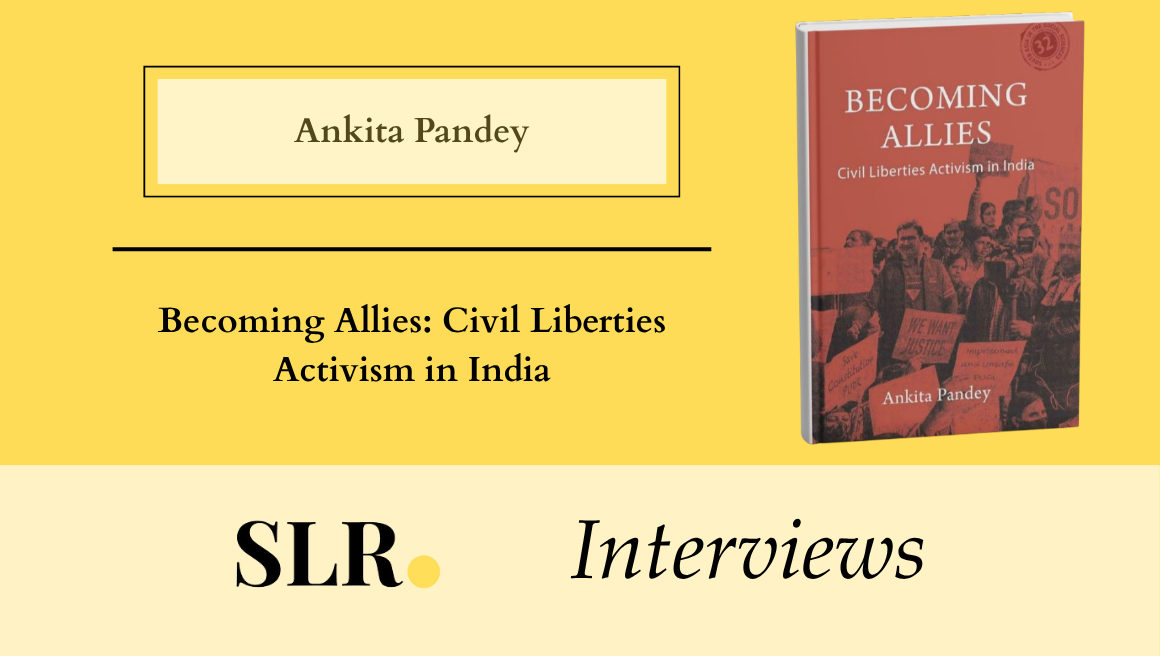
SLR editors Arya Harishankar and Hiranya Gupta sat down with Ankita Pandey to discuss her new book ‘Becoming Allies: Civil Liberties Activism in India’ (Cambridge University Press 2026). In Part II, she turns to how activists remember their pasts, why fact-finding works as a “left legalism” that borrows the form of liberal law, and the shifting nature of allyship in a time of digital activism, virality, and growing suspicion of dissent. Our conversation concludes with a reflection on what it means to research a group that resists being the protagonist of its own story.
In Part I, the conversation traced the origins of the book, why it treats allyship as a politics in its own right, and the dilemmas it carries. This includes reflections on state-facing politics, and the danger of paternalism inherent in amplifying others’ struggles. Read Part I here.
Left Turn to Legalism
SLR: To interpret the interviews that you conducted, you use Kim Rogers’ vocabulary of “artefact of the self” in order to say that remembering is never just one linear account, but as, say someone is giving an interview, one is continuously constructing the event that occurred. Perhaps, this has an impact on the actors themselves. Across your 70 interviews, was there a dominant emotional vocabulary in how activists recalled a particular period, for instance pride, nostalgia, disappointment, etc.? Were there moments where the emotional truth of an account mattered more to you than its factual accuracy?
Ankita Pandey: Your question has taken me back to my fieldwork time. I really enjoyed the field work, the going and talking to people. I was trying to find as many first-generation people as possible, who were active in the 70s and 80s. I was trying very hard to find them since they had retired now.
I also want to say interviewing, and for anyone who wants to interview, it is more emotionally taxing than you might think. I thought when I first went that I would conduct five interviews a day. Then I realised that it does not work like that. This is not just going and switching on a tape and merely recording something and coming back. It actually takes quite a bit from you to do that. In terms of the dominant register, their tone was mostly reflective.
I have written in the book about self-effacement of allies. Most of them were very uncomfortable with being the protagonist of the story. There were also questions posed to me, such as— why do you not join us? Why are you studying us? Is your time not better used by helping the organisation or cause? There were some people who were uncomfortable with the term “activist” to describe them. Their response was “No; I am not an activist; I just did what I had to do. Real activists are people who are on the ground.” There is always this idea and dynamic at play about who is the real activist and who is not. Thus, there was a lot of modesty present that I encountered. There was a lot of reflection. There were also disappointments on what could have been done or done better.
One or two interviewees were at the stage in their life where they were anyways thinking about writing some kind of a memoir. I became some kind of a first draft exercise for them, so it really helped.
As you know, People’s Union for Civil Liberties and People’s Union for Democratic Rights are not very well recognised names. You will not see them in the newspaper frequently. If at all, they will be referred to as a generic name, in the civil rights groups or civil society groups. Some of them were also disappointed by the fact that they could not become as influential and could not do as much as was needed to be done. There was a sense of disappointment that so much remains unresolved even today, and things have become even more difficult today than they were.
One aspect of interviewing older people is that they evaluate you. They ask you questions such as — what do you know about our group? What have you read about our group? Do you know this name? Have you spoken to that person? Have you heard of “Yuva Jan”? There are more than 5-6 interviewees that started by asking me what I knew about the Emergency. Then I had to say something to convince them that my interest was genuine. There is definitely that evaluation being done.
Now, all of this is actually useful ethnographic material for us. All of these are things that we can actually analyse and talk about in the work that we do, and you are absolutely right that people do not remember like a historical tape, which is true for all of us, right? We do not remember things in their sequence. We remember things that made some groove in our head. We remember impactful things, or we remember achievements. We remember terrible failures. We remember something that remained, or something that resonates with us, or remains memorable for some reason. And then when we replay it, it may not give a sense of a chronological development to the researcher quite in the same way as if you could replay some kind of a historical tape. That is not what it is. That is what the artefact of the self really means.
But based on the little that I have read on oral history, the value is not in the recall. The value is not trying to play back some kind of a thing. There is an independent value of that memory and how people remember things and what they consider significant. Of course, both things are important. Of course, you corroborate. You do not just take what people tell you as fact. You go back and you check with other documents in terms of events and dates. But the memory itself and the way it has been told to you is very important. That is as far as the dominant register and the factual accuracy bit is.
SLR: You described fact finding as a form of “left legalism,” revolutionary politics that you pursue through the language of, say, liberal constitutional law. Could you elaborate on that argument and on whether it can still do the work it once did, now that the institutions that it seeks to persuade, like the courts, the press etc. increasingly appear suspicious of such work? And when our institutions such as the judiciary appear compromised, do you think there are limits to the vocabulary of constitutionalism?
Ankita Pandey: I use left legalism to refer to what appears like an interesting paradox. And that is that you have people very often, at least in that period, even more so, of left socialist revolutionary sort of sensibilities or people taking up causes that are broadly in the progressive and in the left domain, but adopting a method or adopting a practice that is very much in the liberal legal domain. So those of us who have an early sort of political theory training will think of liberalism and Marxism as two opposite philosophies and worldviews. Therefore, it was a very interesting paradox for me that there is left politics and there is liberal legalism coming together in this practice of fact finding.
Over time, I have also come to notice that what is interesting in fact finding is the legal form itself creating some legitimacy. When you do something with the kind of rigour that could be admissible in a court of law, something that could become evidence in a public interest litigation, that carries a certain degree of credibility because of its rigour. Even if those fact-finding reports never reach the court, even if they just get published in a newspaper or they just get distributed in university networks and civil society domains, that legal form carries a lot of legitimacy and importance even outside the courtroom. I found it very interesting that social movements use law, not in the sense of them going to the court to change law, but using the legal form itself to make something credible. Can it still do the work it once did? I will say that there are different ways in which you will have to think about what is the work we wanted to do, and we wish it to do. If the government is favourable broadly and if the allies are people who are successful in seeming credible, then of course it can bring accountability. So, in some cases, it has happened that a fact-finding report has ultimately led to an independent judicial commission being set up looking into the cases of violence. In other cases, there has been some degree of accountability sought from local administration or police functionalities etc. When the times are unfavourable, fact-finding has still continued. Fact-finding continues even today, whether it is to record, whether it is to archive, whether it is to fight against erasure of stories. Fact-finding continues to do the work it did, but that work changes based on whether the circumstances are favourable or not, but the practice continues. If it is favourable, it is seeking accountability; if it is not favourable, it is seeking record and archive.
Governments usually do not oppose the findings of a report brought out by civil liberties activists, instead they try to delegitimise the people or the practice of fact-finding itself by claiming that this has been done by monetary funding from foreign sources, or by people who are anti-national, anti-development or not good citizens.
One of the things I regret— it is not a personal regret— but I am saying that we have lost out in some ways. Because these organisations do not have any sort of fixed office and people have joined in and left. There exists a parallel people-generated archive of extrajudicial violence in the country. It is just dissipated amongst many activists and many different organizations, but there is quite a substantial people-generated archive in the country. It is fragmented, but it exists, and it is very valuable.
Ally Activism in the Contemporary Moment
SLR: You compare the movements in Delhi and Kolkata and examine how these movements were shaped by different factors. In the case of Delhi, the Emergency played a huge role. In the case of Kolkata, we see a strong hold of radical politics and the Naxalite movement. Social causes and movements have triggers behind them. In contemporary India, are there any particular movements or instances in the current sociopolitical climate which might be shaping the social movements we have today and in the near future to come? Where do you believe the present and future social movements are drawing their energy from?
Ankita Pandey: This is a question I should honestly be thinking about more, because I am focused on a particular historical period. So, I will share my observations, but they are mere observations. I have not actually conducted any systematic study to say whatever I will say about the contemporary period.
You see, the Delhi–Kolkata distinction was important. I am not saying that all of the people in Delhi think in one way and all of the people in Kolkata think in another, but I realised that a very big number of activists I met in Kolkata referenced the counter-insurgency operations against the Naxalite movement as their formative exposure to violence or conflict that involved paramilitary forces in an urban setting. And many in Delhi talked about the disappointment at the imposition of the Emergency saying, “we never thought Nehru’s daughter could do this.” So, this idea that there is a profound sense of disappointment at the imposition of the Emergency, and some faith that they had in the state, had been shaken at that moment.
Today, the landscape is quite plural. Now, it is not like those are the experiences through which this energy comes. The landscape is that I can think of environmental activism as one sort of domain from which activism on civil liberties happens. I have written a little bit about, and I am beginning to be very interested in, digital liberties activism. There has been litigation against internet shutdowns in the country, unequal digital governance norms, and censorship or content moderation online. I say this because the People’s Union for Civil Liberties (‘PUCL’), which is one of the oldest national civil liberties groups, was actually involved in the Shreya Singhal case. When the judgement was not being implemented, when it was being routinely flouted, the PUCL went back to the court for implementation of its own judgment.
So, there is actually a link between the conventional sort of civil liberties activism and the climate, digital, contemporary activism around gig work, etc., which are also raising essentially similar kinds of questions. And I could tentatively say that with digital governance, I think there is a little less of trying to raise the civil liberties issue after the harm has occurred, and instead a move to look at the pipeline itself, to look at governance itself. But the language in which people do it, the social background of the people that come, and the initial experiences that politicise them are quite different. But I am very glad you asked this, because it has made me think about trying to think further, beyond the 1980s, about what happens to allyship in the country.
SLR: Your book emphasises the fact that allyship, at least in the very initial phases, mobilised credibility more than numbers. We see a lot of social movements emanate and start, and in fact mainly operate, through social media platforms today, through other digital dissemination methods. There is a lot of emphasis on virality, visibility, and audience size. Would you say that this involvement of social media has made the whole idea of the politics of amplification, which we just discussed earlier, better? Does it make it more effective? Does it democratise it by increasing access? Or can it be said to undermine the credibility-based model and how things operated in organisations such as PUCL? Would you say that it is harming that sort of credibility built over the years, or has it in fact enhanced the environment in the country?
Ankita Pandey: I really was impressed with this credibility and virality distinction, and I was thinking that I should actually consider this in a more systematic way in terms of how credibility and virality differ from one another. Let me begin by clarifying the credibility aspect a bit more. So, when we think of social movements, we usually think of numbers on the street, or we think of Twitter storms. There is a mass mobilisation element to social movements very, very often. Now, when it comes to civil liberties activism, the mobilisation is not of numbers, the mobilisation is of credibility, which is to say that maybe only four of us are saying something, but we are respectable, important people whose voices must be taken seriously by those in the establishment.
And of course, it is a relationship. I should be credible in the eyes of the government. If the government does not think I am credible, then I lose that power that I have. But a particular generation of people who came from a certain social background, like I mentioned in the book — doctors, lawyers, academics, journalists, etc., they are seen as respectable people. Their own personal reputation is significant. It is difficult to dismiss them as some sort of irrelevant opinion. When they lend their names to a certain cause, it brings a certain degree of importance to it.
Now, with social media and with amplification, what has happened is that many groups do not actually need a civil liberties group merely to take their claims from a remote location to the national capital, as they can do that themselves. Allies are not required anymore just to get reported or noticed. People can do that themselves using social media. But credibility in the age of virality has actually become even more important. When something goes viral, we are still asking, is this verified? Is this credible? Can it be fact-checked? So, in that sense, virality can do some other functions, but it doesn’t necessarily bring credibility to an issue, and that is still, I think, slow work. Doing investigation, talking to people, collecting information, etc., is still something that is very important. So even in the times of virality, I would say, generating credibility remains a challenging task.
SLR: In your book, you explain that the idea of ally activism is based on not acting beyond your own material interest. A phrase that you used in your book was how the middle class is the “self-appointed custodian” of the ideals of constitutional rights, etc., in the country. Would you say that, again, in the context of, for example, the anti-CAA protests, we saw the movement draw people from certain specific social locations who spoke a different political language? Are we seeing a shift in what background this ally comes from? Is the middle class referred to in your book, that is the concerned citizen, the same as who he was back in the 1980s? Or do we see allies speaking from a particular political language instead?
Ankita Pandey: “Concerned citizen,” I thought, was a very useful category, a very useful self-identification, particularly useful for allies, because it is a way of saying that I have a stake in this issue, which otherwise does not affect me, because I am a concerned citizen. I am not imprisoned, but prisoners’ welfare is important to me because I am concerned. So, the idea of concern — both as, “I am alarmed as a citizen,” and also, “I have a sense of civic responsibility, and therefore I am concerned.” It is a form of citizenship that also allows a contest between the government and people over what is the ideal citizen behaviour. It is like the government has one set of requirements in terms of what is good citizen behaviour, and civil liberties activists have their own sort of understanding of that.
Concerned citizenship very much exists still. It is often the most popular language for expressing solidarity. You will still find many letters that are signed by concerned citizens. It is very much there. But as I was saying previously, I think the social world that produced concerned citizens has changed. The language in which they speak has also changed. So maybe, and I say this tentatively, the people that I met would emphasise more a sense of duty, some kind of a constitutional responsibility. Conscience is a category that would come up, ethics would come up, and left commitments, progressive commitments, would come up; the desire would come up, the desire to practice one’s politics. And from what I observe now, I think there is a greater language of intersectionality, solidarity, and social justice that I see around. Where they are coming from as well as the language that they are using, has definitely changed over time.
SLR: We now constantly see labels such as “anti-national,” “extremist,” and so on, that once came from perhaps the governments and the police, but now appear to be seeping into constitutional institutions as well. Are we watching the state essentially redefine what legitimate allyship looks like?
Ankita Pandey: When civil liberties activists come up with a fact-finding report that is deeply embarrassing for the government, the government is not going to disagree with that report. The government will delegitimise the people who are conducting it. And that has been the case not just with the government of India, but it is true for governments worldwide. All over, governments will delegitimize the source of information that challenges the official version.
And the more the exposure and the more embarrassing the report is for the government, the greater the desire to delegitimise it. And as I mentioned before, this is a very old trope. So, raising questions about the motivation of the activists, calling them unpatriotic, describing them as “anti-national” or “extremist-sympathizing,” and raising doubts about who is funding them —all of that is something we have seen throughout the history of post-colonial India. There is an example in the book of the activist who was opposing the Damodar Valley Corporation. So right from the 1950s and 60s, you have this going on. But the very fact that it has been happening for a very long time tells you that there is an ongoing contest. This is not a settled debate. There is an ongoing contest between subsequent governments and citizens over the question of what is the meaning of a “good citizen”. What does good citizenship mean? The government will define duties in one way, and people will define what they think is their duty as citizens in quite another way. So, who can legitimately speak for the country in a civic role is something that is actually an ongoing battle throughout post-colonial India, and that remains. And I think it also comes with the territory of this activism.
Positionality
SLR: We discussed earlier about how allies are reluctant to be the protagonist of the story. Did this tendency towards self-effacement create particular methodological challenges for you as a researcher, and how did you handle these challenges?
Ankita Pandey: Self-effacement, as I told you, was in itself analytically useful to me. More than seeing it as an obstacle, it became a thing that I analysed. Why is it that all of these people have this shared moral code? How is it that they have come to acquire this shared moral code? But yes, of course, when people are reluctant to talk about their own role, you have to, in conversation, go to the history itself and the practices that happened, and then weave their role into the conversation. As much as they would like to, they will tell you. I think it helps if you can convey to them that your intent is sincere. It also helped that I was not writing a history of the people. In the book, I was analysing a form of politics and not actually looking at people’s history. Activists have written memoirs, and biographies. My focus was on this practice and on the activism itself, and a little less on the activists.
But you are absolutely right that if you are ever in a situation where you are interviewing people who are reluctant to be the protagonist of the story, it means you have to employ other means. So, I tried asking friends about each other and that helped. Instead of asking them if they were comfortable, I would ask, “apart from you, who else was there, and what were they doing?” Sometimes people are happier to talk about each other than about themselves. Sometimes you can ask children about their parents. In some cases, activists never bring that side to themselves into the family, so their children remember them as regular parents helping with arithmetic and homework. But sometimes they do remember the activism. So, if one is focused and sincere about wanting to know certain aspects, other ways can be found. But as I said before, the book is not about the life stories of individual people, but their activism. Thus, this was not the biggest portion of my focus.
SLR: After spending years researching people who chose to intervene in struggles that did not directly affect them, do you consider yourself an ally in the sense developed by the book? And has researching ally activism changed how you think about the responsibilities of scholars towards struggles in which they’re not directly implicated?
Ankita Pandey: I hesitate to describe myself as an ally of activism just because I wrote a book about allyship. I also think that it is not a status that one can claim for oneself. It is a relationship between the cause that you want to spotlight and you, so the people and you. But I would say that, given that allies are unseen in social movement literature, in that sense, the book can be thought of as an exercise in amplification. I am putting a spotlight on an overlooked actor within the social movement domain. And to that extent, maybe I am doing some kind of an amplification for activists who are part of civil liberties groups.
In terms of my own responsibility as a scholar, I do think that scholars should not just be reporting. And there is not a way to report without actually taking positions. I will say that it is true that allies are doing very important work. Democracy cannot survive if each of us is only thinking about our narrow self-interest. We cannot build coalitions and solidarities with those whose shoes we have not been in. That would be a terrible shame. Allyship is very important and quite needed in a democracy in today’s times.
Ankita Pandey
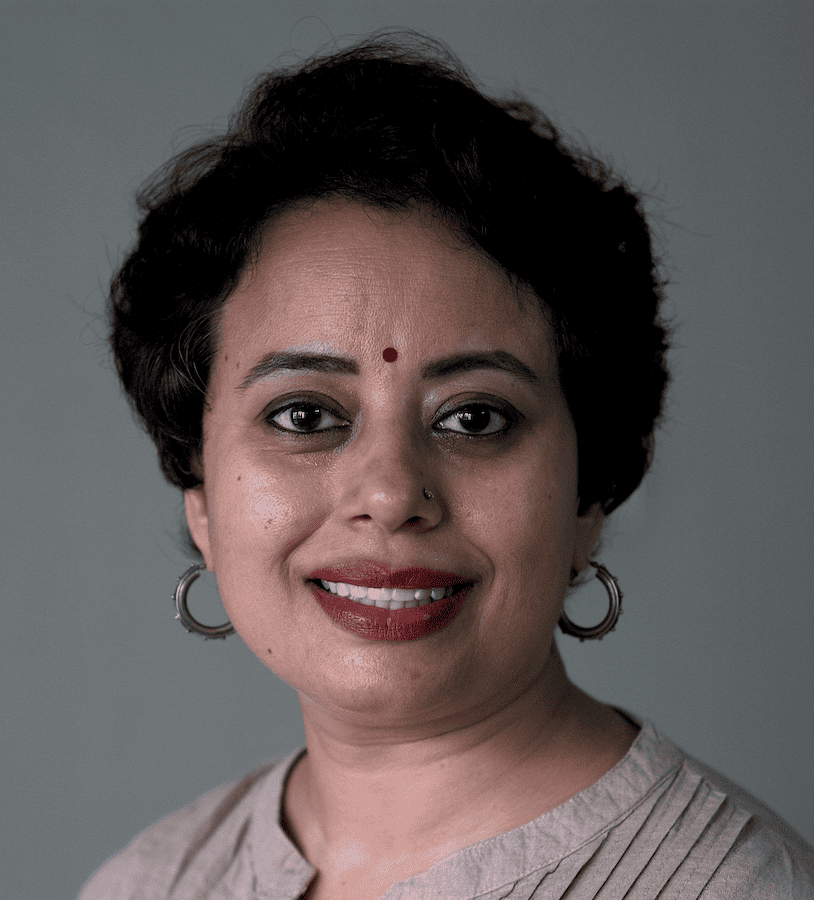
Ankita Pandey is an Associate Professor, Political Science, at O.P. Jindal Global University, and a Research Associate at the Oxford School of Global and Area Studies, University of Oxford.