Grief Lessons
Carson in My Classroom
Anne Carson, the Canadian poet/essayist/classicist, has won the Nobel Prize for Literature this year. And the internet is almost breaking down.
Grief is the primary undercurrent in all of Anne Carson’s work: not eventful, exciting grief, but grief as the fundamental human condition. It is the stark obliqueness of expressing grief in language where the plot thickens. Carson doesn’t describe extraordinary events or objects of suffering; she invokes snow, wind, water, trains, kitchens, boyfriends, Helen, Aphrodite, Hektor. Carson gets at love sideways—something that happens as one rides the train and shovels snow at the doorstep.
I taught excerpts from The Glass Essay in the larger collection Glass, Irony, God1 in March 2026 in a course that I called Writing Culture(s). The last module in my syllabus was called Home, and Carson fit right in as the last text of the course. She writes about kitchens a great deal, and snow, and Greek gods, piles of dishes, and pajamas, and the TV. Carson, in my course, served as a rather heavy counterweight to the wayward men (Paul Theroux and his descendants) who could only write if they were shocked out of their wits. Carson is not shocked. Carson goes nowhere (physically, I mean). Carson sits at the kitchen table and contemplates the Greeks. Carson’s Hektor comes home tired from the war and turns on the telly.
She writes in Autobiography of Red in segment IX, called ‘Space and Time’,2 ‘Love does not make me gentle or kind, thought Geryon as he and his mother eyed each other from opposite shores of the light.’
Carson makes the Indian classroom strange. She is not exiled, diasporic, evicted from her homestead by Partition. Her contemplation of home along the pathways of language and time are essential triggers for classroom intrigue as also classroom ambivalence. This consistent inducing of minimal discomfort is what makes Anne Carson a modern heroine of the written word.
Grief
Carson’s grief is always married to the Greeks and spread out onto the tapestry of snow. In her 2022 essay ‘On Snow’ in the London Review of Books, she writes:
There is a strand of tradition that reads ‘hoar frost’ in place of ‘smoke’ but no one knows what to do with that. The same week my mother died my boyfriend left. (Beware the conversation that begins: ‘Do you think people should be completely honest with one another?’) We’d been together a number of years but he was young and closeness to death made him queasy. Do I blame him? I admit I was not a very erotic person at the time. And well, my quotient of astoundedness was full. He drove me to the funeral and more or less kept going. I more or less waved goodbye.
And a bit later in the essay:
The reason I went to visit my mother, the week before her death, was a dream I had. A young man in red epaulets was ministering to a room of restless guests who lay fully clothed in bathtubs. Waking suddenly (3 a.m.) I knew the young man in red epaulets as the night clerk in the hotel where I stayed when I visited her. Strange choice for a psychopomp, I thought, as hours later the train glided west in a weak tarnish of dawn. There was ground fog everywhere, then afternoon sunlight (the bus) so deep you could enter it as a lake. Finally a taxi gliding past people in their kitchens.
Snow becomes a voice in the essay. Like the low trombone in a night orchestra, it pierces the reality of pain and relationships to externalise it. It is from Carson that we learn that inside and outside are the same thing. A taxi, a kitchen, the ‘fog’ which is ‘so deep you could enter it as a lake’, are side characters that populate the conversation between the author/protagonist and snow. She captures the peculiar melancholia of northeastern Canada—a literary sociologist might say. One might also add to this diagnosis that the peculiar pain of social alienation in the condition of modernity is externalised in the voice of the snow. At the end of the essay, she recounts a phone conversation between her and her mother who lives in a facility for the elderly:
I say this now to remind myself how words can squirt sideways, mute and mad; you think they are tools, or toys, or tame, and all at once they burn all your clothes off and you’re standing there singed and ridiculous in the glare of the lightning. I hung up the phone. I stared at the snow for some time. I expect she did too.
She drives a knife through the heart with those lines. This is North American loneliness. This is also a universal human condition. Carson rises above being a poet of Canada or North America or the West. She uses little to no sociological detail. She uses components of absolute banality to construct her story. She doesn’t invoke war, genocide, poverty, extractive capitalism, minorities—the popular vocabulary of being correct in the literary world. She does not try to seduce her reader with urgency. Instead, she runs a knife gently through your heart and collects the seeping blood in her palm, which then coagulates into poetic language. Her craftsmanship is quiet. Like the pitpat of early morning snow.
The Prose Poem
I did not understand the prose poem until I read Anne Carson’s The Glass Essay and the collection Plainwater3(especially the prose poem Anthropology of Water in it). Here, she writes:4
Those things that cut across the time are what you remember, voices cutting across sleep/
“Agua!Agua!” ripping through my siesta like a color.
Red. The color that speeds through the land as we move into the mountains again. Sections of brick red soil mark out the green plantings of the hills as they rise. Poppies flash along the roadside, amid dark chunks of rusted bread. At noon, the cicadas let their read throats crack open. Red, My Cid informs me, is the only color wolves see: this is taken as clear testimony, in ancient Celt- Iberian belief, that they are genuinely royal animals.
She starts telling a story: a story that meanders by its own will and has no definitive endpoint. In these lines, Native American, midwestern America: where the soil is red, flowers and bread are also red. Carson writes the prose poem like a dream journal. I am particularly fond of The Anthropology of Water—not least because I am an anthropologist. A story and a road-trip across the heart of America emerge from these opening lines; redness and roadness are abstracted deftly out of their concrete surroundings. Red is no longer a quality of other things—it is an entity by itself. Road goes from being a physical object to being a quality of existence. She talks at length about pilgrims’ walking journeys along difficult terrain. The pilgrim, she says, ‘is never free again, according to the terms of the freedom he finds while bound to the road’.5 The pilgrim is forever embedded in roadness.
About 40 pages into the poem, she writes:6
Is there something I’m not getting? Classical Chinese wisdom recognizes five conditions of getting. It is not like. It is like. It is only like this and not like anything else. It is. The ultimate nature of conditions, for example, is just like water. The ultimate nature of water is like the pleasure of men.
Conditions are just like water—they morph, change form, become something completely different over time. Carson is cheeky in her likening of the profane—in this case, men’s sexual climax—to the most pristine of things, wind, snow, water, mountains. Water and men flow from Carson’s pen as morphing objects: shapeshifting, malleable, resilient.
Time: A Battlefield
An aging father and a difficult mother recur in the lines of The Glass Essay. I quote from the segment ‘KITCHEN’:7
Kitchen is quiet as a bone when I come in.
No sound from the rest of the house.
I wait a moment
then open the fridge.
Brilliant as a spaceship it exhales cold infusion.
My mother lives alone and eats little but her fridge is always crammed.
After extracting the yogurt container.
And a little later:
Girls are cruelest to themselves.
Someone like Emily Bronte,
Who remained a girl all her life despite her body as a woman,
had cruelty drifted up in all the cracks of her like spring snow.
We can see her riding herself of it at various times
with a gesture like she used to brush the carpet.
She breathes Charlotte and Emily Bronte into the melancholic Canadian kitchen. Mundane cruelty of women leaks out of the ends of lace curtains.
In the second poem of Plainwater, titled The Truth About God, she writes in the last segment ‘God’s Work’:8
God’s own calmness is a sign of God.
The surprisingly cold smell of potatoes or money.
Solid pieces of silence.
From these diverse signs you can see
how much work remains to do.
Put away your sadness, it is a mantle of work.
Potatoes and money emerge as vehicles of sadness. It is god’s work to ‘put away your sadness’. Is this resilience? Is this reconciliation? I feel as though Carson is cheekily and profoundly pointing out how cheap it is to ponder on sadness while there is a whole mound of grief right there on which the world is built.
Time heals, they say. ‘It doesn’t, what a joke!’ says Carson, at least in my imagination. Time emerges as a canvas in which Carson inserts a bunch of board pins—Emily Bronte being one of them.
Coda
Carson is a classicist in her interrogation and attack of the discipline of linear time (I am not talking here of the various Greeks in her poems and her translation work on Sappho). Carson brings the ancient right into your winter kitchen table, talking to your mother. The ancient is no longer a curiosity on the mantlepiece. Carson goes foraging across time to find literary and artistic friends.
What strikes me most about reading and absorbing Carson’s work for a few years now is that she is unperturbed by the fashions of the literary and intellectual world. She doesn’t invoke the popular motifs that are rewarded by these fashions. She never once shies away from her deep attachment to the category of the West, its ways of living, its canons, its frustrations, its ultimate melancholia. Carson is perhaps the only modern great that tells stories of the universal human condition, unencumbered by the pressures of specificity.
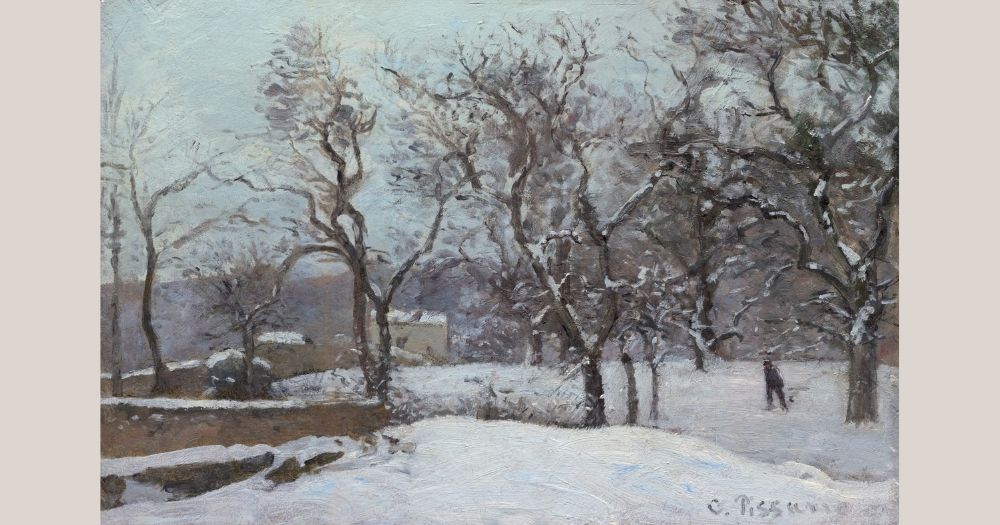
Image credit: Camille Pissarro. Snow at Louveciennes, 1870. The Art Institute of Chicago.
Atreyee Majumder is Associate Professor, Social Science, National Law School of India University. She is the author of Time, Space, and Capital in India: Longing and Belonging in an Urban-Industrial Hinterland (Routledge 2018).