What does the Public Policy Job Market Look Like in India?

Public policy has fundamentally changed the nature of governance around the world over the past 2 decades and more. Policy education programmes have mushroomed in the Global South and adopted their own models different from the western context.1 While comparisons will be made to the US and UK policy markets, such comparisons seem premature, because we are yet to understand the rapidly growing Indian policy market on its own terms. In the context of a developing country like India, despite a proliferation of courses offered by private institutions and universities offering public policy degrees—indicating the demand for such professionals—information on the public policy job market is lacking.
Which organisations hire for public policy positions? Where are these jobs located in India and what do they entail? While there is some ongoing work on what constitutes public policy education in India;2 what constitutes public policy practice and the nature of related jobs is not fully known. While Phadnis, Aggarwal, and Naveen3 underscore the increasing acceptance of policy degrees and career opportunities in non-profit, private, and public sectors, Sajjanhar4 highlights the rise of consultancy and think tank-based expertise as a growing elite body of intellectuals. Additionally, a related question that arises is about the characteristics of the jobs being advertised, which while being labelled as ‘public policy’ are possibly attributing different meanings to that label. For instance, does a job related to public policy fundamentally involve ‘regulating a behaviour’, providing technocratic solutions to social problems, or designing nudges for behavioural change? It is possible that given the diversity of the job market, jobs in public policy go beyond these characteristics.
In this piece, we seek to identify key characteristics of the public policy job market by analysing information on organisations and job descriptions available online. Studies analysing job descriptions have primarily focused on identifying skills and knowledge for employability and the nature of jobs in contemporary governments.5 Adopting a similar approach towards the Indian job market, we first look at scale: the diversity and distribution of the types of policy organisations to understand market composition and segmentation in the sector. We then focus on scope: job eligibility requirements and responsibilities to understand the meanings and outcomes associated with them and thereby public policy practice in India.
The analysis is based on a dataset comprising 698 unique job descriptions6 collected from various portals till the year 2024. This data was collected by searching for public policy jobs on LinkedIn and job portals, such as Naukri.com, Indeed, and IIM Jobs, on a rolling basis. The process essentially involved an archival search for job descriptions containing the phrase ‘Public Policy’. We then scrutinised each job profile to validate whether the jobs were related to public policy practice, broadly construed. Finally, we removed duplicates (roles advertised on multiple portals or re-advertised at a later date) and any job description with limited information or not clearly identifiable as public policy positions.
This analysis has three parts. Part 1 describes the composition, diversity, and predominance of organizational types in the public policy job market. Part 2 describes the diversity and composition of job profiles in terms of their requirements and expectations. And Part 3 presents observations emerging from the preceding two parts about the public policy profession in India.
I. The Public Policy System
To understand organisational types that populate the policy system, we used the self-referential labels organisations use to identify themselves and aggregated them into broad categories. Mindful that categorisation can affect the distribution of organisational types, we provide below a brief description (also as justification) of each category, followed by their sub-types.
Expectedly, the public policy system can be broken down into five broad categories: not for profits, corporates, consulting firms, academic research, and other specialised agencies (Table 1).
Not for profits, comprising around 37 per cent (254/691) of all jobs analysed, includes organisations that identify generically as ‘not-for-profit’ or qualify themselves by specifying a sector, such as a not-for-profit working in education, environment, or public health. Apart from NGOs, social enterprises, advocacy groups, and monitoring and evaluation organisations are also included under this category. Public policy jobs in this category tend to be ‘horizontal’ or staffing functions that support all line functions, remaining only a few steps removed from direct community intervention.
Private sector corporations, comprising 16 per cent (116/691) of public policy organisations, include technology conglomerates, multinational corporations, and financial services firms. Roles here are similarly removed from the company’s primary product, focusing instead on government relations, corporate social responsibility and data governance, and digitalisation. These could also be horizontal functions that involve interfacing with the government to build relationships and supporting corporate social responsibility objectives of an organisation.
Attracting significant attention due to their growing influence, the consulting industry comprises around 19 per cent (133/691) of the jobs in this dataset. Unlike the intervention-focused (a sectoral programme or a product) institutions above, consulting firms are client driven, serving governments and other entities. This category includes strategic advisory firms, professional service firms, accounting firms, business consultancies, and other policy consulting firms. They offer advice across specialisations, ranging from regulatory, operational technology, and communications to niche fields like behavioural sciences.
The fourth field focuses on research and comprises 24 per cent (160/698) of total analysed jobs. These positions are housed within educational institutions, such as business schools and universities, or within dedicated research centres working on legal, economic and social, and general policy research.
The fifth category are organisations directly affiliated with the central or state government ministries and directorates or with multilateral organisations, such as the UN. These comprise less than 5 per cent of the overall jobs in the dataset. Their underrepresentation could be because governments rarely use LinkedIn or other portals to advertise contractual positions.
In sum, one can say that not-for-profits, corporates, consultants, policy research, and direct government jobs comprise the bulk of the public policy market. Aaron Wildavsky,7 one of the earliest public policy educators and an eminent implementation scholar, had envisioned policy graduates working both outside and inside the government. Public policy practice spans both for-profit and not-for-profit sectors, which together dominate the job market. Other organisations offering positions in the field include political consulting, media and communications, advisory bodies of specific industrial and professional associations, and financial and technological intermediaries.
Public policy practice is, metaphorically speaking, no longer confined to the enclaves of Lutyens’ Delhi. Unsurprisingly, while around 40 per cent (276/691) of jobs are located within the Delhi/National Capital Region (NCR) (Figure 1), multi-location jobs account for 23 per cent (162/691) of the total jobs analysed. Multiple-location jobs include options across two or more cities or pan India remote postings, which are agnostic to location. Bengaluru, Hyderabad, Mumbai, and Pune cover the next set of locations, followed by opportunities spanning the country—from Kochi in the south to Kohima in the Northeast and Jaipur in the west.
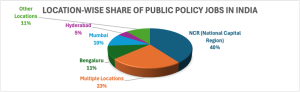
Cross-tabulating this information—identifying which cities are known for what kind of public policy practice—presents a more complex picture of what the public policy system looks like in India. Table 1 indicates that most jobs in the Delhi NCR region are in the non-profit and development space, followed by research and academic institutions. Consulting and professional services constitute a significant section but rank lower than non-profit and research institutions even in Bengaluru and Mumbai. Public policy positions in the government and public sector account for the lowest share across all locations.
Table 1: Number and share of public policy jobs in NCR, Bengaluru, Mumbai, Hyderabad, and other locations
| Location | Not for Profit (NFP) & Development | Corporate (Private Sector) | Consulting & Professional Services | Research & Academic Institutions | Government & Public Sector | Total Jobs | ||||||
| National Capital Region (NCR) | 102 | 40.2% | 45 | 38.8% | 57 | 8.2% | 64 | 10.7% | 8 | 1.1% | 276 | 40.5% |
| Multiple Locations | 63 | 24.8% | 24 | 20.7% | 28 | 3.9% | 38 | 5.6% | 9 | 1.4% | 162 | 23.3% |
| Bengaluru | 22 | 8.7% | 22 | 19.0% | 10 | 1.4% | 17 | 2.4% | 2 | 0.3% | 73 | 10.5% |
| Mumbai | 24 | 9.4% | 12 | 10.3% | 16 | 2.3% | 17 | 2.4% | 1 | 0.1% | 70 | 10.0% |
| Hyderabad | 10 | 3.9% | 2 | 1.7% | 4 | 0.6% | 17 | 2.4% | 0 | 0% | 33 | 4.7% |
| Other Locations | 33 | 13.0% | 11 | 9.5% | 18 | 2.6% | 7 | 1.0% | 8 | 1.1% | 77 | 11.0% |
| Grand Total | 254 | 36.8% | 116 | 16.0% | 133 | 19.0% | 160 | 24.5% | 28 | 4% | 691 | 100% |
Source: Authors’ calculations
II. Requirements and Expectations of Public Policy Jobs in India
This section examines job eligibility requirements and responsibilities to understand how organisations perceive the two, which together constitute public policy practice. To analyse responsibilities and requirements, we employed the topic modelling method widely used for qualitative analysis. Topic modeling is an unsupervised machine learning technique that discovers ‘topics’ from a set of frequently used words by finding patterns, which helps in summarising data. We used a specific algorithm called Latent Dirichlet Allocation (LDA), a probabilistic model that applies the bag-of-words approach to discover topics based on frequency rather than word order. It is often used to analyse online job advertisements across industries.8
Topic modeling of responsibilities and requirements reveals five distinct yet interrelated themes that highlight the complex nature of public policy work in India (Figures 2 and 3). Each panel in the figures represents a latent topic, where the horizontal bars show the most frequent words and their corresponding beta values—the probability that a particular word belongs to that topic. A higher beta value indicates stronger association, helps interpret how clusters of responsibilities/ requirements relate conceptually, and determines the theme for that cluster or topic.
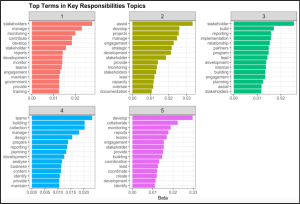
In the first topic, the highest beta terms are stakeholders, manage, monitoring, contribute, develop, and reports, indicating a deep focus on relationship management and oversight. Terms such as engagement, government, provide, and training suggest responsibilities involving capacity-building and coordination with public authorities. The second topic reinforces these responsibilities with dominant words, such as assist, develop, projects, manage, engagement, strategic, and stakeholder. This reflects roles combining program management with planning and support, where professionals assist in project execution, prepare documentation, and contribute to institutional strategies.
The third topic shifts the focus towards program implementation with terms such as stakeholder, build, reporting, implementation, relationship, partners, and program. This cluster emphasises relationship management—maintaining partnerships, strengthening institutional linkages, and ensuring that implementation processes are effectively documented and communicated. The fourth topic highlights operational and technical dimensions through words such as teams, building, collection, manage, design, prepare, reporting, and analysis. Responsibilities here are internally focused, involving teamwork, data collection, preparation of materials, and analytical tasks that support program design and evaluation. The fifth topic integrates elements of coordination and collaborative development with words like develop, collaborate, monitoring, reports, engagement, stakeholder, coordination, and lead. This suggests that policy professionals are expected to not only execute and monitor projects but also facilitate collaboration across actors, coordinate activities, and provide leadership in multi-stakeholder environments.
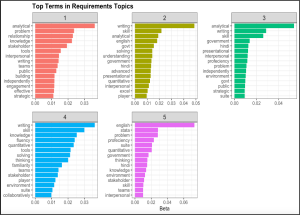
Regarding job requirements, the most prominent terms in topic 1 include analytical, problem, relationship, knowledge, stakeholder, and tools. The relatively high beta value for analytical indicates that analytical reasoning is central to this cluster, complemented by problem-solving abilities and stakeholder awareness. This topic reflects roles that require structured thinking, familiarity with policy tools, and the ability to build relations. The presence of interpersonal, writing, teams, and engagement suggests that analytical capability is expected to operate alongside collaborative and communication skills rather than in isolation.
Topic 2 is strongly related to writing, followed by skill, analytical, English, and solving. This cluster emphasises written communication and language proficiency as foundational competencies. References to government, hindi, presentation, and quantitative indicate that employers value bilingual or multilingual abilities and the capacity to communicate complex information clearly in formal settings. Topic 3 similarly centres on analytical and writing, but adds stronger institutional orientation through government, public, and strategic. This blends analytical rigour with public-sector awareness and strategic thinking, highlighting the expectation that policy professionals understand bureaucratic contexts while maintaining strong presentation and independent working abilities. This aligns with scholarly work that suggests modern policy roles have shifted towards stakeholder engagement and collaborative responsibility,9 requiring professionals who can navigate complex networks and joint implementation processes.
Topics 4 and 5 further differentiate technical and communication-related requirements. Topic 4 combines writing, skill, knowledge, fluency, quantitative, tools, and solving, reflecting a hybrid model in which technical literacy—particularly quantitative and software tools—is integrated with clarity of expression and familiarity with policy environments. Repeated presence of teams, stakeholder, and collaboratively indicates that even technical roles require strong teamwork. Topic 5, in contrast, is dominated by English, followed by STATA, problem, proficiency, and quantitative. The prominence of STATA signals explicit demand for statistical software skills, emphasising the increasing importance of data-driven analysis in policy positions. The co-occurrence of thinking, knowledge, environment, and interpersonal further indicates that technical competence is expected to function within collaborative settings.
Collectively, the five requirement topics point to an evolving policy job market that values hybrid profiles—professionals capable of combining empirical analysis with communication and organisational skills.
III. Bridging the Skills Gap in Policy Education
These findings on the scale and scope of public policy job descriptions reflect a demand in the Indian policy landscape for professionals who bridge the gap between technical expertise and collaborative, communicative, and adaptive skills necessary for effective policy governance. Our findings align with Henderson and Chetkovich,10 who noted the use of skills like communication, policy analysis, and workload management by graduates of the Master of Public Policy (MPP) program at Harvard Kennedy School in 2004–05. Mukherjee and Maurya11 have further highlighted that technical, entrepreneurial, and managerial skills along with public sector relevant skills have become increasingly important for regulatory work in the industry and private sector. Our analysis corroborates these findings and shows that the Indian job market requirements are even more diverse, with stakeholder engagement and management being a key component along with communication, writing, and presentation skills and technical policy knowledge.
Broadly speaking, public policy professionals are viewed as managers, and not so much as expert technical specialists—professionals who integrate a variety of skills while occupying the middle to senior strata in an organisation. In other words, they are not expected to engage with the impacted constituents or communities to a great extent. Instead, they enhance the scale and scope of government work and are assigned to leadership roles as they gain more experience. Job descriptions also emphasise context-specific language requirements, such as Hindi. Our research situates public policy positions as highly networked and coordination-intensive. While most jobs are in Delhi NCR, where key ministries and government bodies are located, policy jobs also exist in other cities, such as Bengaluru, Mumbai, and Hyderabad, and sometimes pan India.
Policy roles demand professionals who can simultaneously coordinate partnerships, oversee implementation, manage teams, and contribute to programmatic development within not-for-profit, profit, corporate, and government organisations. Such findings are crucial for refining the curricula of public policy schools mushrooming in India, ensuring students receive the appropriate skills for employment.
- OG El-Taliawi, S Nair, and Z Van der Wal, ‘Public Policy Schools in the Global South: A Mapping and Analysis of the Emerging Landscape’ (2021) 54(2) Policy Sciences 371–395; S Nair, OG El-Taliawi, and Z Van der Wal, ‘Public Policy Education in the Non-Western World: Changing Context and Content’ in The Future of the Policy Sciences (Edward Elgar Publishing 2021) 70–84.[↩]
- A Phadnis, S Aggarwal, and K Naveen, ‘Evolution of Public Policy Education in the Global South: The Case of India’ (2025) 31(1) Journal of Public Affairs Education 18–40.[↩]
- Phadnis, Aggarwal, and Naveen (n 2).[↩]
- A Sajjanhar, ‘The New Experts: Populism, Technocracy and Politics of Expertise in Contemporary India’ (2022) 52(4) Journal of Contemporary Asia 653–677.[↩]
- HL Chen and Y Zhang, ‘Educating Data Management Professionals: A Content Analysis of Job Descriptions’ (2017) 43(1) The Journal of Academic Librarianship 18–24; M Howlett and AM Wellstead, ‘Policy Analysts in the Bureaucracy Revisited: The Nature of Professional Policy Work in Contemporary Government’ (2011) 39(4) Politics & Policy 613–633.[↩]
- By unique job descriptions, we mean that each row did not have the same information across all columns. It could be the case that while the organisation was the same, the position or the location would be different and were counted as different jobs. Additionally, there were some positions that we have labelled as located in ‘multiple locations’. These jobs were open to being located across India, such as multi-city locations (pan India or a combination of cities, including ‘Delhi/Hyderabad/Lucknow’), were remote positions, or were open to locations within a single state (Gujarat, for example). Lastly, NCR positions included jobs located in Delhi, Gurugram, Noida, and Faridabad.[↩]
- A Wildavsky, Speaking Truth to Power: The Art and Craft of Policy Analysis (2nd edn, Transaction Publishers 1989).[↩]
- F Gurcan and C Kose, ‘Analysis of Software Engineering Industry Needs and Trends: Implications for Education’ (2017) 33(4) International Journal of Engineering Education 1361–1368; F Gurcan and NE Cagiltay, ‘Big Data Software Engineering: Analysis of Knowledge Domains and Skill Sets Using LDA-Based Topic Modeling’ (2019) 7 IEEE access 82541–82552.[↩]
- C Pollitt and G Bouckaert, Public Management Reform, A Comparative Analysis – NPM, Governance and the Neo-Weberian State (3rd edn, Oxford University Press 2011).[↩]
- M Henderson and C Chetkovich, ‘Sectors and Skills: Career Trajectories and Training needs of MPP Students’ (2014) 20(2) Journal of Public Affairs Education 193–216.[↩]
- I Mukherjee and D Maurya, ‘Public Policy Education in India: Promises and Pitfalls of an Emerging Disciplinary Identity’ (2023) 16(1) Journal of Asian Public Policy 53–74.[↩]
Srikrishna Ayyangar is Associate Professor, National Law School of India University, Bengaluru.
Devyani Pande is Assistant Professor, National Law School of India University, Bengaluru.