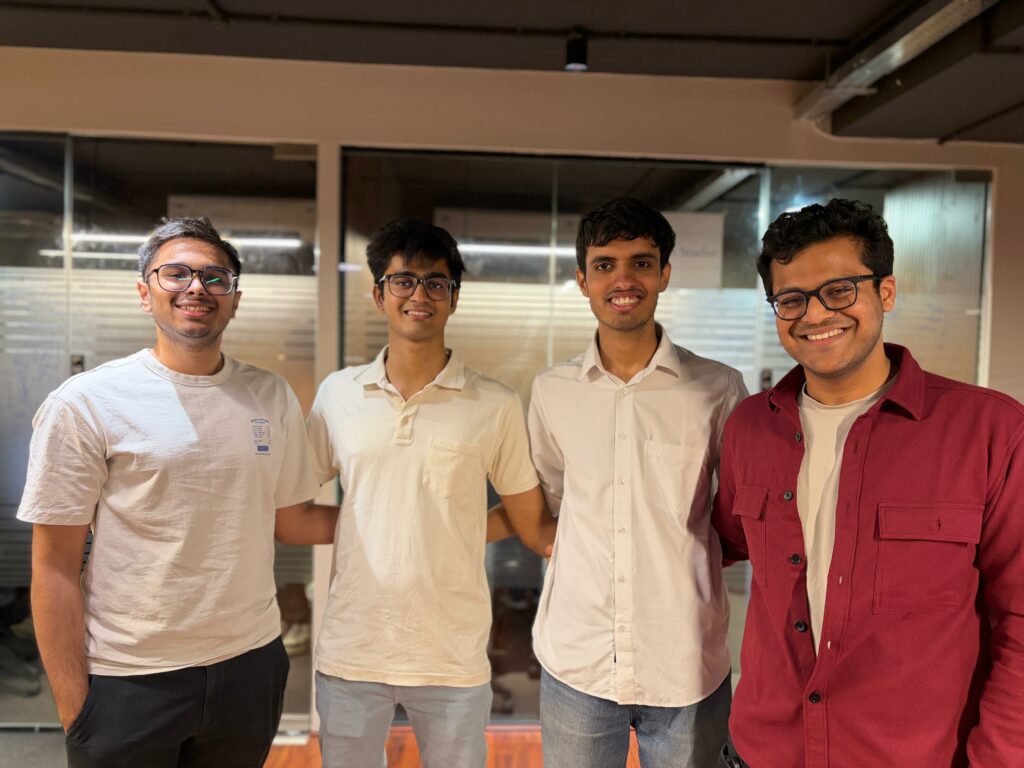
A Conversation with the Founders of Lucio AI : Vasu Aggarwal and Darsan Guruvayurappan
Introduction
Hello everyone, it is a pleasure to welcome Vasu Aggarwal and Darsan Guruvayurappan, co-founders of Lucio AI, to this interview for the Indian Journal of Law and Technology. My name is Samik Basu, and I am accompanied by my co-editor Gourav Bishnoi today. To provide a very brief background about our guests today, Vasu and Darsan graduated from the National Law School of India University in 2023, after which they founded a startup called Lucio AI, a legal intelligence workplace that simplifies complex legal work such as drafting, review, and research.
We would firstly like to congratulate you on raising $5 million in venture capital funding, as well as on your recognition in the Forbes India Top 30 Under 30 list for 2026. What makes your journey especially exciting is how recent it is. Having graduated just a few years ago, you continue to be a huge source of inspiration for a lot of students at NLS and other colleges. We are delighted to have you with us today.
Section I: From NLSIU to Entrepreneurship
- What motivated your transition from NLSIU and conventional legal career paths to the startup ecosystem? How did the idea for Lucio AI (previously, EazyDraft) first take shape?
Vasu: Thank you for the kind introduction and for the congratulations, we really appreciate it. We started Lucio AI with a fairly simple mission: we wanted to help lawyers fall in love with the law again. When we were in law school, we had a lot of friends and seniors we really looked up to, they were extremely bright, energetic people who were genuinely passionate about the profession. But after they entered practice, especially in the first few years, many of them became disillusioned.
As law students, you imagine that legal practice will be intellectually stimulating all the time, that you’ll be arguing complex matters in boardrooms or courts. But the reality of the early years is often very different. A lot of the work is repetitive: drafting similar documents, reviewing long files, compiling notes, and doing fairly mechanical tasks. It’s a grind that you have to go through before you reach the more interesting parts of practice.
When we saw that happening to people we admired, we began thinking about whether technology could change that experience. Around the same time, generative AI tools were starting to emerge, and for the first time it felt like technology had the potential to meaningfully transform how lawyers work. That’s where the initial idea came from. We thought if drafting is one of the biggest pain points in legal practice, maybe we could build tools that automate or assist with some of that work. That was the starting point for Lucio AI.
Darsan: The idea itself actually developed quite informally. We were roommates throughout law school; we lived together from first year all the way to the end and we spent a lot of time discussing what we wanted to do after graduation.
One night we were just talking about the future, about careers, about whether we wanted to do something unconventional. One thing led to another, and suddenly it was around four in the morning and we were thinking: maybe this is the time to build something.
We were in our fourth year at that point. Fifth year was relatively lighter academically, so we thought it might be the perfect window to experiment with the idea and see if we could build something meaningful before graduation.
- You (Vasu) had a training contract lined up with an international law firm. How did you decide to forego that opportunity and continue with the startup?
Vasu: Yes, I had secured a training contract with Herbert Smith Freehills in London. That’s something you work really hard for during law school. You go through the entire process of securing internships, performing well enough to get a PPO (Pre-Placement Offer), and then eventually landing that training contract. It’s not something people walk away from lightly.
Initially, I still kept that option open. When we released the first version of Lucio AI, I hadn’t yet applied for the visa for the training contract. I technically still had some time to decide. But during those months, we were having so much fun building the product that it changed how I thought about the decision. The process of building something from scratch, that is solving problems, meeting people and figuring out how to turn ideas into reality was incredibly exciting.
So eventually the decision became simpler than it might seem from the outside. I realised that I genuinely enjoyed what we were doing. And once you feel that excitement about building something, it becomes difficult to walk away from it.
Darsan: There’s also a very personal element to these decisions. Sometimes you just want to build something with people you enjoy being around. We had been roommates for years, we had done a lot of things together in law school, and we knew that we worked well as a team. When you get an opportunity like that, when you’re surrounded by talented people and you feel excited about the idea, and that it’s worth taking the leap.
Of course it wasn’t easy. In the beginning we had nothing: no funding, no office, just an idea and the willingness to work on it. But that uncertainty is also part of the fun.
- Looking back, do you think the knowledge and skills you picked up in law school helped you in your journey as entrepreneurs?
Vasu: Yes, definitely. One of the most valuable things law school teaches you is how to learn. Think about what you do in law school. Every trimester you’re dealing with multiple subjects that you’ve never encountered before. You might have to write several research papers within a few months on topics you initially know nothing about.
You start from scratch: reading cases, analysing scholarship, forming arguments, and then producing a well-structured paper. And you do this repeatedly over five years. What that process does is it removes your fear of unfamiliar problems. When you’re building a company, you constantly encounter things you’ve never done before – engineering, hiring, sales, fundraising, product development, etc. But because law school has already trained you to quickly learn new domains, you develop the confidence to approach those challenges.
Samik: Just to add to that, whenever someone asks me about what’s my biggest takeaway from NLSIU, I generally say that law school has taught me how to think about the law, rather than simply teaching me the law itself.
Vasu: I totally agree with that. In fact, one may say law school is teaching you how to think at a more fundamental level, which I feel is invaluable for whatever stream one chooses to pursue in their career.
Darsan: The environment of law school also plays a big role. At NLS you’re surrounded by some of the smartest and most driven people in the country. A lot of learning happens outside the classroom as well through conversations, debates, competitions, and even student politics. For example, the elections for student positions or editorial boards can get extremely intense. People are reading the student body constitutions, interpreting rules, making arguments, organising campaigns. At the time it feels chaotic, but in hindsight you realise that it teaches you negotiation, persuasion, and strategic thinking. Those skills are surprisingly useful when you’re building a company.
- Many law students still see litigation and corporate law firms as the default career paths. What alternative trajectories do you see emerging?
Vasu: Our advice to students is very simple: do what you enjoy doing. There isn’t a single correct path. Some people love litigation, some enjoy transactional practice, some want to work in policy or academia, and some might want to build companies. There is no right path. Whether it is litigation, corporate law, research, starting a company, working in a company, or even becoming a cricketer, the important thing is to do something that feels natural and meaningful to you. Once you enjoy what you do, work stops feeling like work. That is what makes the choice easier. So be curious. Explore things. Work hard. Learn as many things as you can. Be willing to pick up new skills. That is what we look for in great people: the right intent, the right energy, the willingness to work hard, and the motivation to make the community better. The specific skills matter too, but the foundation is curiosity and effort.
What’s interesting today is that we’re seeing the emergence of cross-functional roles for lawyers. Lawyers are moving into product development, business strategy, marketing, technology, and entrepreneurship. Legal technology in particular is becoming a major field. AI is going to become a huge part of how lawyers work, and that means there’s a growing need for people who understand both law and technology. So, if someone is interested in that space, they should explore it just as seriously as they would explore litigation or corporate law.
Darsan: Particularly, legal tech is also interesting because it allows you to develop a broad skill set. When you’re working in a startup, you don’t just do one thing. You might be involved in product development one day, business development the next day, marketing the day after that. You get exposure to multiple domains, which helps you develop a generalist mindset. In terms of skills, the most important things we look for are curiosity, willingness to learn, and the motivation to work hard. Specific technical skills can always be developed later.
Section II: Building Lucio AI
- What were the primary challenges you faced while building Lucio AI?
Vasu: The early days of any startup are extremely challenging. And to be honest, the challenges never really disappear; they just change. In the beginning, the difficulty is figuring out whether your idea even makes sense.
You’re constantly talking to users, testing features, and iterating on the product. Later on, new challenges appear, hiring the right people, managing teams, scaling the product and expanding into new markets. When we started Lucio AI, it was just the two of us working out of an apartment. We had no money, no team, and no guarantee that things would work out. But gradually, people began joining us.
Darsan: One of the most exciting moments was when our friends from law school decided to join the company. Within about six to eight months, a few people from NLS reached out because they were excited about what we were building. Some of them actually left stable law firm jobs to join us. That was a big moment because it showed that other people believed in the vision as well.
- What exactly does Lucio AI do?
Vasu: Lucio AI supports a broad set of workflows that a commercial lawyer typically handles, whether the lawyer is a litigator or a transactional lawyer. Broadly, we work across four areas: review, research, drafting, and email assistance.
By review, we mean helping lawyers work through long documents, including case bundles, transaction packs, and case law materials, and perform tasks on those documents more efficiently.
By research, we mean helping users find relevant case law, statutes, regulations, and other legal materials that help them understand the legal position.
By drafting, we mean assisting with contracts, redlines, briefs, and other documents. Lucio AI can work with templates and playbooks, compare documents, and help users assess whether something is correct or requires revision.
By email, we mean everything from searching inboxes to drafting emails and redlining them.
Darsan: So, the product is designed to sit inside the practical legal workflow. It is not just a generic AI tool. It is aimed at the actual tasks lawyers spend time on every day.
- With global players and general-purpose models becoming stronger, how is Lucio AI differentiating itself?
Vasu: When we started, the legal AI landscape in India was still taking shape. We pride ourselves on being among the first to push the market into legal AI. The major adoption cycle in India started only recently, and we were closely involved with clients who helped educate the market and create awareness.
Today, as more firms and companies build in legal AI, differentiation matters a great deal. One of the most important ways we differentiate ourselves is by quality. We are very customer-obsessed and user-obsessed, which means we focus heavily on the product experience. There are also broader advantages. Bangalore has a very high density of talent, and that helps us build products that are qualitatively different. Of course, there are larger international players with much higher funding. But what keeps us moving ahead is the way we build, the quality we try to deliver, and the fact that we want to provide useful solutions at a price that users can actually justify.
- Who are your current clients, and do you see individual practitioners or drafting chambers adopting such tools soon?
Vasu: We work with a broad set of clients. That includes large law firms in India, small and mid-sized law firms, some individual practitioners, and clients across the United States, United Kingdom, EU, and UAE
As for adoption, I think every professional worker will increasingly use AI going forward. It is a productivity booster. It improves quality and reduces turnaround time. Litigation chambers have very specific needs, and AI lends itself well to them: case bundles, chronologies, fact patterns, cross-examination preparation, pleadings, translations, and messy documents in general. So yes, I think adoption by individual practitioners and chambers is already underway and will only grow.
Our larger goal is simple: we want every lawyer to use AI to improve the quality of their work and improve efficiency. Ideally, we want lawyers using Lucio AI in a way that helps them finish their work better and faster, so they can actually enjoy their time outside work as well. That is really what drives us.
- In India, legal data is often fragmented and unstructured. What challenges did that create while building AI systems?
Darsan: One of the earliest things we realised when we started working on legal AI was how messy legal data actually is especially in India. A lot of people assume that the main challenge is building the AI model, but in reality, the harder part is often dealing with the data itself.
One of the first projects we experimented with involved helping automate certain aspects of FIR documentation. That’s when we got a real sense of the problem. The data was incredibly inconsistent. You would have FIRs written partly in Punjabi, partly in English, sometimes typed, sometimes handwritten. Some sections would be structured; others would just be free-form text. These documents were never created with machine processing in mind.
So, before you even begin applying AI, you have to solve a number of foundational problems: digitisation, OCR, language recognition, formatting inconsistencies, and so on. Even when the text exists digitally, there’s very little standardisation in legal writing. Contracts, pleadings, and judgments rarely follow a uniform structure. That’s very different from jurisdictions like the United States where systems like PACER provide relatively structured datasets. Even there the data isn’t perfectly structured, but at least it exists in a more consistent digital format.
In India, you often have to build that infrastructure yourself. A lot of the work is engineering work, building pipelines to clean data, standardise it, and make it usable for AI systems. That’s why we now have a large technical team working on these problems.
Vasu: Another important part of the process is building datasets. We rely on a mix of sources- open datasets, proprietary datasets that we’ve built ourselves, and collaborations with third parties. For example, in India we’ve compiled large datasets from various regulatory and judicial bodies like the RBI, SEBI, competition tribunals, electricity tribunals, real estate tribunals, and so on. We organise that data in a way that makes it usable for AI systems.
At the same time, in other jurisdictions we sometimes collaborate with partners who already have specialised datasets. So, it’s really a hybrid model. The goal is to combine different sources and structure them in a way that allows AI systems to reason over legal information effectively.
- How do you see AI changing work at law firms, especially for junior lawyers?
It’s true that AI will change the nature of certain tasks that junior lawyers currently perform. Many early-career tasks involve reviewing documents, compiling chronologies, extracting facts, drafting routine documents, or summarising research. AI can definitely make those processes faster.
But the broader context is important. The amount of legal work in the world is not decreasing, if anything it’s increasing. Businesses are growing more complex, regulations are increasing, and cross-border transactions are becoming more common. So, while AI may reduce the time required for certain tasks, the overall demand for legal services is still expanding. What AI really does is improve productivity. A lawyer using AI effectively can often complete tasks much faster and produce higher-quality work. That doesn’t necessarily eliminate the need for lawyers, it just changes how they operate.
Samik: On a more personal note, to conclude, I think what has stayed with me most from this conversation is just how much of this began from something very simple – conversations, curiosity, and the willingness to try something without having everything figured out. As a student, it’s reassuring to hear that uncertainty isn’t something to avoid but something you can actually build from. So, thank you both for sharing your journey so candidly, it’s been genuinely grounding, and I’m excited to see where you take Lucio AI next!