Between Lectures | Interview | Justice Zakeria Mohammed Yacoob with Arvind Narrain
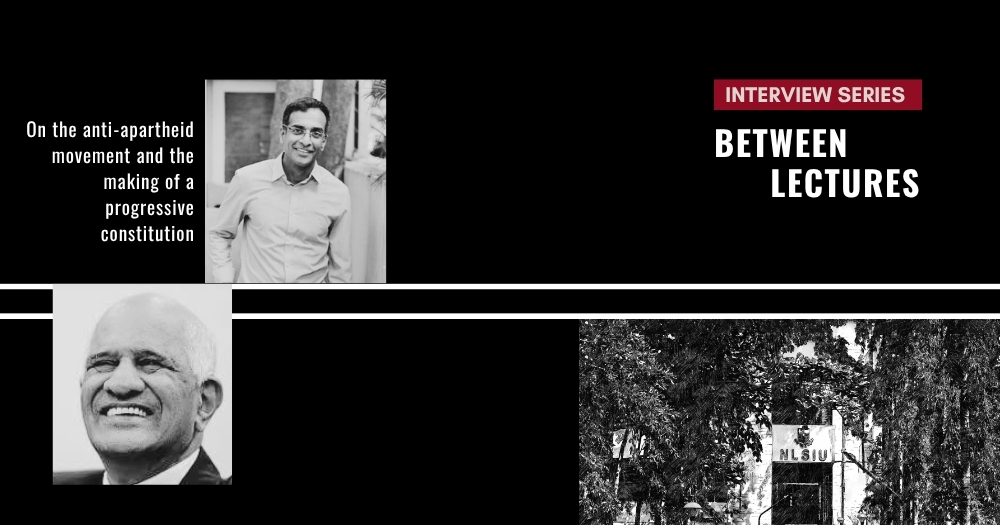
‘Between Lectures’ presents interviews with renowned practitioners in conversation with NLSIU faculty members. This series features the extraordinary lives and work of people that have shaped legal practice, policy interventions, and social action.
Justice Zakeria Mohammed Yacoob, retired judge of the Constitutional Court of South Africa, played a direct role in shaping South Africa’s constitutional future and was an active participant in the anti-apartheid struggle. During his tenure in the Constitutional Court from 1998–2013, he gained recognition as one of the court’s most principled voices on equality, human dignity, and social justice. This was exemplified in Government of the Republic of South Africa v Grootboom, a unanimous judgment he authored that upheld the right to adequate housing.
When he visited NLSIU in January 2026, Arvind Narrain—Founding Member of the Alternative Law Forum, well-known advocate of civil and LGBTQIA+ rights, and Visiting Faculty at NLSIU—interviewed the judge. In the edited version below, Justice Yacoob shares many aspects of his life—growing up blind, playing an active role in the African National Congress, and participating in the process of drafting and finalising the country’s constitution. These also reflect South Africa’s broader historical trajectory of a post-apartheid State that went on to have one of the most progressive constitutions. NLSIU’s Consulting Editor Janani Ganesan also joined in the conversation.
Arvind Narrain (AN): Justice Yacoob, it’s not often that we get to talk to judges who have been part of the making of their Constitution and various civil rights movements. It’s an extraordinary privilege to be here with you today. I’ll begin with this: could you tell us a little bit about growing up in apartheid South Africa? What was that like for you?
It was hard. I didn’t know that apartheid existed when I was at school because that’s what that environment does to you. So, if you’re a blind kid at a school and you listen to a radio, which is sanitised by apartheid, you don’t hear anything about the struggles for democracy or the African National Congress [ANC]. And there were all sorts of events from that time that made headlines, but when our teachers read the newspapers out to us, they didn’t broach controversial things. I asked one of the teachers later why that was so and they said, ‘We didn’t want to trouble the children too much.’ But that, I thought, wasn’t a good enough answer.
Before I joined school, I had a very, very disciplined home environment as my father wanted me to become a Hafiz. By the time I was seven years old, I had become a Hafiz-e-Quran, which means that I had memorised the Quran. And I was this boy wonder—this blind kid who used to read namaz at the mosque. There’s a thing called taraweeh [special prayers performed during the month of Ramadan], where every day you read one sipara [a chapter or section of the Quran]. I used to perform a quarter of the taraweeh in the Verulam Mosque [near Durban] on a regular basis. That too was a very important part of my experience because that developed my memory.
At home, it was a sin to speak English and if I did, I got a hiding straightaway. No questions asked. That was part of my upbringing. But my father had the sense to send me to the school for the blind. Somebody had recommended this to him and he thought it was the best thing to do, although he was concerned that they wouldn’t be caring towards me. It was with a heavy heart that he decided to send me to this school. Back in the day, it was very difficult to get parents to send their children to a school for the blind. The school was small, the classrooms were small, but the infrastructure was good.
In 1966, when I matriculated as a blind pupil, I was perhaps the most uninformed matriculant ever. I knew nothing about the struggle for democracy. I knew nothing about the ANC. And I actually thought that African people were inferior, that white people were very good, and if I tried hard enough, I could be as good as a white person.
When I went to the University of Durban-Westville in 1967, two things happened to me. The first was that I joined a left-wing Marxist-Leninist group. The second was my encounter with my first lecturer at the university, a white man. He was so inept and inadequate as a lecturer that I was immediately cured of the notion that white people were better. Whenever I intervened with a comment, he would say, ‘Oh, yes, thank you, Mr. Yacoob; I was just about to say that.’ White lecturers who were not good enough for other universities were sent to ours. The assumption was that this was a university for Indians, it didn’t need good lecturers. But there were Indian lecturers too, who joined on merit, because they had no jobs anywhere else. So, we had wonderful Indian lecturers. That cured me of the notion of white superiority.
We also formed relationships with a medical school nearby, which was full of African students. It was a highly politicised campus and all these kids were studying to be doctors! I met African people there who were 10 times as clever as I and this too dispelled the notion in my head that African people were inferior. Then I got involved in the struggle for democracy, qualified as a lawyer, did some work, remained involved in popular struggle, and that led to everything else.
AN: In the history of your country, are there any events during the apartheid era that particularly stand out for you? Like the murder of Steve Biko or the Soweto Uprising, perhaps?
I was old enough when the Soweto Uprising occurred and it certainly moved me a great deal. The uprising demonstrated dissatisfaction against the apartheid regime, and therefore, the ringleaders of the Soweto Uprising were encouraged to become part of the underground movement of the ANC. So that helped with organising and mobilising quite a lot. It was a wonderful thing. The uprising happened because African people were forced to learn in Afrikaans in school. People protested. One child called Hector Pieterson was shot dead by the police during the protests. When that happened, everything went haywire. The police got into big trouble. It’s sad to say it, but the death of that kid motivated everybody, because people were so angry about it and so determined to do something that the support for the apartheid struggle increased considerably.
AN: The other moment that is very significant is Mandela’s imprisonment for 27 years. Can you reflect a little bit on your life at that time?
When he went to prison in 1961, I was a small boy and he was on trial between 1962–63. So, I didn’t hear about Mandela until I got to university in 1967. Although I was a participant in the struggle too, I was very junior, so I did not associate directly with Madiba at that time (we used to call him Madiba affectionately). But I knew about him and was part of the Release Mandela Campaign when he was sentenced to life imprisonment. I think it was this campaign that resulted in his release.
A few years before his release, I began having some direct contact with him. After he was released, around the time the negotiations for democracy had started, he asked to see me. He used to call me ‘boy’. I had been appointed to the first Electoral Commission, responsible for managing our first election. I was relatively young in age, 42, while he was an experienced campaigner. He said, ‘Boy, you see, I know that you are a disciplined member of our political organisation. I thank you for that. But I know that you may face a conflict of interest because, on the one hand, there’s loyalty to the African National Congress and, on the other, you’ve got to participate in an election where you’ve got to make sure that it is free and fair for everybody. I know that you must find that difficult because you’re a disciplined member. I called you here, boy, to give you an instruction. And my instruction is that when you are in the Electoral Commission, you are forbidden to take our side.’ Now, I would love to see a president who will say to a commissioner, ‘Please, don’t take our side.’ Madiba did that.
Another example of his greatness was while I was in the Constitutional Court. As the president of the country, Nelson Mandela promulgated important regulations, but these regulations had not been passed by Parliament. At the Constitutional Court, we set aside Mandela’s regulations and said that the ANC government must go to Parliament and do it properly. There was a bit of a hoo-ha politically and publicly about this. And he was sensitive to public opinion. But he went on TV two days later to tell the public that he had accepted the court’s decision completely. Having read the judgment, he was satisfied that the Constitutional Court was right. He conceded that he should not have gone about it this way. Not only did he carry out the directive of the Constitutional Court but also went on TV because he understood public opinion and wanted to say that the court had been right.
AN: Could you tell us a little bit about the making of the South African Constitution? What would you say it gives to the world of constitution-making?
One of the most important things in the South African Constitution is the right to human dignity. The second is socio-economic rights. The third is equality and affirmative action.
I want to share two things about the equality provision. Firstly, it includes a prohibition on discrimination against people on the basis of their sexual orientation. I was actually responsible for introducing this into the Constitution, and it was intensely debated before it was passed. You can’t compare that with the Indian Constitution, because had our Constitution been drafted in 1947, I doubt whether the drafters would have thought gay and lesbian rights were important. All of society in the 1940s and 50s was affected by a level of discrimination, I think. But by the time we drafted our Constitution [which was adopted in 1996], there was already a lot of writing on this. One of our co-judges in the Constitutional Court, Edwin Cameron, was gay.
Secondly, not knowing I was going to be a judge in the future, I put in a clause in the equality provision that said judges’ salaries shall not be reduced. Everybody said, you knew you were going to become a judge at that time, and I remember when it came up for discussion. Cyril Ramaphosa, who is the country’s president now but was the chairperson of the Constitutional Committee at that time, asked me to provide the reason for this provision. I told him, if there’s a problem in relation to anyone else’s salaries, they would go to a court to put it right. I don’t think it is right to put judges in the invidious position of fighting about their own salary increases. That would not do. Ramaphosa and everybody else clapped and said, that’s right, and that clause was approved.
AN: You’re right, the South African Constitution is perhaps the first in the world to have non-discrimination on grounds of sexual orientation. From your biography, I learnt that you were also part of the Delmas Treason Trial. And one of the people in that trial was Simon Nkoli, who was both out as gay and part of the liberation movement. Please tell us a little bit about that. I mean, how did you, in your personal life, get to an awareness that sexual orientation should be grounds for non-discrimination? Did you personally know people who were gay or lesbian?
It was a process. Firstly, it was theoretical recognition that gay and lesbian people were human like myself. Secondly, I did start getting to know people who were gay. I had at least 10 friends who were gay and lesbian, friends who were gay couples and lesbian couples, and so on. And I liked them and enjoyed their company. There were women who lived together and men who lived together, and slowly it made me realise that there was absolutely nothing wrong with it at all. There’s even a Muslim group in Cape Town that says gay and lesbian people must be able to come to their mosque. And gay marriages … that’s the other judgment I was part of in the Constitutional Court. We went much further and said gay and lesbian people have the right to get married if they want to and it now happens on a regular basis in our country.
AN: The Constitutional Court of South Africa itself is so remarkable. We, from India, look at it with envy. When we got independence, all our judges were formerly part of the colonial regime. They just continued seamlessly into the post-Independence era. But if we look at the Constitutional Court of South Africa, the judges were part of the struggle.
That’s because those who were part of the struggle were lawyers before apartheid came to an end—like me and many others. I don’t know if your struggle at that time had lots of lawyers?
AN: There were lots of lawyers here too. Nehru, Patel, and Ambedkar were all lawyers. All the top leaders were.
Yeah, but they went into politics.
AN: Exactly, they didn’t enter the judiciary.
Once you go into politics, you can’t be a judge. There was an offer for me to join politics too. When I was appointed to the Electoral Commission, Ramaphosa, who was the organising secretary of the ANC at the time, called me early on a Sunday morning to say, ‘You are number eight on our list. On the other hand, you’re also on the Independent Electoral Commission. So you have to decide whether you want to remain number eight.’ Now, number eight on the list is very high, because there would have been 400 people on the list. So, I could have been a minister with no trouble. But I had decided long ago that I was not into political power. I was involved in the struggle for democracy, which was a different thing. Once we had democracy and people could be elected and so on, my life was going to be different. I was not going to go down the route of becoming a politician, because I already understood then that there would be lots of opportunism. I didn’t expect corruption to be so high, but I knew that there would be opportunism because politicians are opportunists, right? I didn’t want to join the opportunistic league. I said to Ramaphosa straight away, ‘Don’t worry, strike my name off the list. I’m happy to serve on the commission.’ I avoided politics like the plague.
AN: Looking back at your time in the court, is there any decision that you are extraordinarily proud of?
I’m very happy about Grootboom and the consequences of that. I’m generally happy about all our judgments, but having thought about it, I am unhappy about one of my judgments, a dissenting one. The majority came to the conclusion that people who have relationships without getting married, provided that the relationship is of a marital nature, must be treated in exactly the same way as people who are. And I wrote a judgment, wrongly, to say I understood that as things stood in our country, there was a difference between married and unmarried couples. I supported the idea that we should recognise the advantages of marriage for what it was, because it was an important institution in society. I read that judgment now and I am not happy.
AN: Over the years, would you say that there’s been a shift in the character of the Constitutional Court of South Africa?
No, not an essential shift. But there’s a change in the sense that different people do things differently. Which is not a bad thing, because new and younger judges think differently. We therefore proposed a constitutional provision that Constitutional Court judges can only be in the court for a maximum of 15 years. The reason we put this in is that the judges of the US Supreme Court go on until they are 90, 95 and they don’t want to leave. As far as we were concerned, change was essential. And to have a dynamic court we decided we must have different judges to cater to different circumstances at different times. I disagree sometimes with the language they employ, but I’ve never had a debate about the final correctness of any decision that the Constitutional Court has made since my retirement.
AN: I was just coming to it from this angle—if you look at the Supreme Court of India, the post-1950s was fairly conservative in terms of constitutional interpretation. The judiciary only found its rights voice post the Emergency. I was wondering if it would be fair to say that the Constitutional Court of South Africa had the greatest rights flowering in the period just after its Constitution came into place, when judges had that philosophy of being from the anti-apartheid movement. Do you think that has changed? Do you feel that judges don’t have that background of the struggle anymore and does that make a difference?
They may not have the background of the struggle, but African judges would be well aware that the struggle is the reason they are there. Of course, they have to apply context, which they do; they learn about the context. Whether you are part of the struggle or not, you take it into account. And we have no judges—thank god—who are guilty of discrimination themselves or who think that the apartheid era was good. In fact, if you said that in the Judicial Services Commission, you would never get appointed.
AN: That is a very interesting point of how the legacy of the anti-apartheid movement has continued into the functioning of the South African State. Could we look at the case filed by South Africa against Israel in the International Court of Justice as an example? It’s extraordinary. It comes from a certain kind of understanding to acknowledge that Israel is committing genocide, that Israel is an apartheid State. This suggests that a certain legacy continues in these issues.
It’s wonderful, and I must tell you this, that just before this decision was taken, I was down in the dumps because I was thinking what the hell have we done here! The comrades I had in the past are now in government, and many of them are as corrupt as hell. I was feeling very, very low about how things were going along in South Africa. And then they made this decision and it lifted my spirits completely. It was wonderful and, in fact, I might even vote for them because they took that decision.
AN: Would you say it’s because of the connecting link, in a sense, between the PLO [Palestine Liberation Organization] at that moment in time and the anti-apartheid movement?
Absolutely, the context played a very important role. Remember that all these judges who are, say, 60 years old now, remember that apartheid ended 31 years ago in 1994, which means that when apartheid ended they were 21–22, and as children there was that exposure to it. The history is there, you know.
I haven’t read enough of your cases to know whether your judges would take into account the struggle for democracy in your country, the struggle for self-determination shall we say.
Janani Ganesan (JG): In your discussion with the faculty members on campus, you mentioned that you had not borrowed from Indian judgments. Could you tell us why?
I have not read many of them. I had recourse to some of them. But at that time, apart from Indian Supreme Court judgment in relation to the right to housing, I found myself disagreeing with many of the judgments, including the court’s attitude to the right to life and the death penalty and so on. So, I didn’t find Indian judgments in 1994 very impressive. I didn’t find many judgments that went to the heart of the matter in relation to people.
JG: What were some of the other jurisdictions you referenced?
The only other jurisdiction we looked at was Canada and to some extent Germany. But with Germany, it was difficult due to language. Canada used English. And if you look at Canada, it has a similar structure and similar way of doing things. So, we had recourse to Canadian courts quite often. The only time we referred to the courts of India, that I remember, was in relation to their validation of the death penalty, which we disagreed with.
JG: And what about during the making of the Constitution of South Africa? What were some of the constitutions you looked at and drew inspiration from?
We looked at the German Constitution, the Indian Constitution, and the so-called Constitution of Britain. But more importantly, we looked at many human rights judgments and the United Nations fora—that helped us a great deal too.
Justice Zakeria Mohammed Yacoob is a retired judge of the Constitutional Court of South Africa.
Arvind Narrain is a visiting Faculty at National Law School of India University.