The Curious Case of the Indian Farmer and Farmers’ Varieties
On 10 June 2025, Mr Sasidharan C achieved a milestone by registering a rice variety named ‘GOPIKA’ (REG/2019/60) under the extant variety (Variety of Common Knowledge) category1 before the Protection of Plant Varieties and Farmers’ Rights Authority (hereinafter the Authority). Later that year, two other farmers, Ms Mousumi Biswas and Mr Bajrang Lal Kasva, successfully registered a rice variety (M-JAMINI, REG/2021/0187) and a wheat variety (BLK-BALAJI, REG/2020/10), respectively, as new varieties.
These datapoints are specifically important in the Indian plant variety protection regime. The trio achieved something no other farmer has in the 25 years since the enactment of the Protection of Plant Varieties and Farmers’ Rights Act 2001: they successfully registered plant varieties under categories other than the farmers’ variety.2 To put it otherwise, despite an explicit provision allowing farmers to register different classes of varieties as breeders,3 these three represent the sole exceptions who have been able to do so.4
There have been a significant number of farmer registrations under the Act since the process began. This is seen as an indication that it has successfully encouraged farmers to innovate and recognised their efforts. However, the data also reveals that farmer applications have been almost exclusively funnelled into a single category (the farmers’ variety) of the four that are registerable under the Act.5 Though the rights derived from the registration are similar across all categories of varieties, the application process is distinct. It is also important to note that farmers variety, by definition, includes only existing varieties and not new innovations by farmers. Moreover, it is not merely a question of classification, but how the system records and legitimises these innovations. This article highlights this gap by examining the plant variety registration data and the process of application. It seeks to elucidate that, contrary to dominant literature, higher farmer registrations does not necessarily signal the Act’s success.
The Act’s Promises
The Protection of Plant Varieties and Farmers’ Rights Act (hereinafter the Act) has created a sui-generis system for registering plant varieties and recognising the contributions of farmers and breeders. It treats farmers and breeders as coequals under the registration process,6 meaning that the Act allows farmers, who have bred and developed a new variety, to seek registration and protection in the same manner as the breeder of a variety.
As per the Act, plant varieties can be registered under four categories subject to the fulfilment of the Distinctiveness, Uniformity and Stability (DUS) test. The four categories are: (i) new variety, a novel variety bred and developed by the applicant; (ii) extant variety, a pre-existing variety, which does not require novelty; (iii) farmers’ variety, which includes traditionally cultivated varieties, landraces, and wild relatives of a pre-existing variety; and (iv) essentially derived variety, predominantly derived from existing varieties while retaining the expression of all essential characteristics and is also distinguishable from the original variety. Reading Section 14 along with Section 39(1)(i) and Section 23 of the Act, a farmer can register a plant variety any of the four categories.
The Administrative Reality
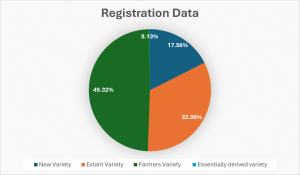
According to the dataset available on the plant authority website, 10,885 certificates of registration have been issued by the plant registry as of 31 September 2026. Of these, 49.32 per cent registrations are under the farmers’ variety category, amounting to nearly half of the total registrations. Meanwhile, only 17.56 per cent are from the new varieties category and 32.99 per cent from the various subcategories of the extant variety. A negligible 0.13 per cent falls under the essentially derived variety, as shown in the Figure 1. This distribution of registrations raises the question as to who and what is recognised under the system and how they are being categorised.
Even though the Act separately permits farmers to apply under all four categories, the registration data reveals a striking picture. While most new variety registrations, which require a novelty standard, are done by private applicants, the extant variety registrations are more equally distributed between public institutes and private applicants (see Table 1 for a detailed breakdown). On the other hand, the farmers’ variety category comprises almost entirely of farmers, groups of farmers, and farmer organisations and welfare NGOs. Additionally, of the total applicants identified as individual farmers, almost all of them are exclusively captured under the farmers’ variety alone. Interestingly, under the extant variety category, three applicants, including Sheehan Genetics LLC, Nuziveedu Seeds Ltd, and the Indian Council of Agricultural Research, have been recorded as farmers, which leaves us to ponder over how the Authority actually categorises applicants. The registration data hence shows that farmers have entered the system almost exclusively through the farmers’ variety category.
Table 1: Category wise breakdown of applicants from January 2009–August 2026
| Registration Category | Private Applicant (in Percentage) | Public Agriculture Institution (in Percentage) | Farmer (in Percentage) | Individual Breeder (in Percentage) |
| New Variety | 85.09% | 14.81% | 0.05% | 0.05% |
| Extant Variety | 45.11% | 54.78% | 0.11% | 0% |
| Farmers’ Variety | 0% | 0.02% | 99.98% | 0% |
| Essentially Derived Variety | 100% | 0% | 0% | 0% |
The language of the Act, while separately permitting applications for the extant variety and farmers’ variety under Section 14, also creates a statutory confusion. This overlap was previously observed by veteran scholar NS Gopalakrishnan. He argued that the Act contemplates two types of farmers’ variety: one that falls within the extant variety category under Section 14(b) read with Section 15(2) of the Act and another that falls under Section 14(c) read with Section 39(1)(ii). While Section 14(b) of the Act identifies extant variety as a registerable category, Section 2(j)(ii) recognises farmers’ variety as a subclassification of the extant variety category. On the other hand, Section 14(c) identifies farmers’ variety as a separate registerable category. Hence, as per the Act, a farmers’ variety could be a primary category under Section 14(c) or a sub-category under Section 14(b) read with section 2(j)(ii). Gopalakrishnan asserted that neither the plant authority nor the Act clearly explains how these two possibilities should be distinguished. Moreover, in practice, as seen in the registration data, only three sub-categories, ie, extant variety, extant variety (Notified) and extant variety (Variety of Common Knowledge) have been recorded under the extant variety category.
The question then remains as to how should a farmer, who creates and develops a new variety, be treated under the law. Or should it be assumed that farmers have stopped innovating post 2005, when the registration process first began, to explain this gap?
The application forms complicate this dilemma further by not offering a ‘farmer applicant’ category in its new and extant variety forms; farmer applicants can only apply as an ‘individual breeder’, like Mr Kasva, or by choosing the ‘any other’ applicant option. Despite this, Ms Biswas’ was recorded as a farmer applicant in the list of certificates published by the Authority on its website.
This classification has administrative and fundamental significance as it determines the process of application and grant. For instance, a farmers’ variety application form requires an endorsement by an institutional authority, such as the chairperson or secretary of the concerned panchayat, while new variety applications do not have a similar mandate.
Case Studies from Kerala
These questions initially emerged in my 2019 field research on two cardamom varieties registered under the Act in Idukki, Kerala.7 They were called Ela (Reg: 340 of 2017), also known as White Flower Cardamom, and Elarajan (Reg: 370 of 2016). Ela was developed by the farmer KJ Baby in 1999. He selected a cardamom plant with distinct white flowers, developed it through vegetative propagation, and stabilised the variety over several years. He subsequently commercialised the plant through sale of saplings. Elarajan was similarly developed by his son, KJ Benny, in the same field over 5 years. He later also sold the planting material to farmers and research institutions.
Each of these processes involved observation, selection, propagation, stabilisation, and dissemination; and not merely preserving a traditional variety. The Indian Institute of Spices Research, which facilitated the registration for both, described them as cultivars developed by farmers and therefore farmers’ varieties. The National Innovation Foundation, recognising their contribution and innovation, presented prestigious national awards to both KJ Baby (2007) and KJ Benny (2012).
Despite being farmer-developed and commercially disseminated varieties, which received technical validation and institutional recognition, they were nevertheless classified as farmers’ varieties. Though both varieties would have lost novelty due to prior commercialisation, questions remain as to why the Authority never recognised them as extant varieties either.
The Three Anomalies
This brings us back to the breakthrough registrations of 2025. The commonality among all the registrations is that these innovations were developed by farmers in their field through the employment of a combination of informal breeding techniques. The first farmer, Mr Sasidharan, developed GOPIKA by crossing two other varieties, Jyothi and Aishwarya, through a process that lasted several years.
The second farmer, Mr Kasva, developed the BLK-Balaji variety from a commercially released variety through a process of pure line selection, starting from 2011 till 2015. This variety was evaluated and found superior by various research institutes.
The third registered variety, M-JAMINI, was developed by Ms Biswas by selecting and crossing two varieties, Lolat (Local Cultivar, female) and IR 36 (male), in 2009. The selected parental plants were crossed manually to produce the first-generation (F1) seeds. It was only by 2016 that she stabilised the variety and by 2017 started multiplying its pure line seeds and distributing them to other farmers for on-farm trials.
None of these varieties fit the definition of a farmers’ variety as they are neither ‘traditionally cultivated and evolved by the farmers in their fields’ nor ‘wild relative or land race of a variety about which the farmers possess the common knowledge’. This made them eligible to be registered as a new variety or extant variety, depending on which specific requirements they fulfilled.
Interestingly, all three applications were backed by the National Innovation Foundation. Could this be taken to mean that farmers’ applications have been merely sidelined because they did not receive structured institutional interventions?
Conclusion
The available evidence does not establish that farmers stopped innovating once the Act came into force.8 It instead shows that farmer-led innovations have been indiscriminately filtered into the farmers’ variety category. The cardamon case studies suggest that farmer-developed varieties have been technically validated, institutionally recognised, and commercially disseminated while still being classified as farmers’ variety. Consequently, the system has often cited the high number of ‘Farmers’ Variety’ registrations as a shield to claim the Act is a success, while the ‘New Variety’ space remains exclusively dominated by private companies and public institutions.
The larger question is: while the Act recognises farmers as custodians as well as breeders, does this classification obscure the distinction between conserving a variety and deliberately creating, selecting, stabilising, and disseminating one. The 2025 series of registrations suggest a possible change in how the Authority processes and records farmer-related innovations, treating them as nuanced cases rather than forcing them into a single category. But a vital question persists: do these cases represent a genuine institutional shift towards systemic correction or is it a set of rare anomalies made possible by structured intermediary support.
The registration data also raises questions about legal visibility and institutional classification. How should a farmer-developed variety be categorised as new, extant, or farmers’ variety? The answers require further comparison of the applications, institutional correspondence, testing procedures, and post-registration outcomes in all these cases.
- The registration numbers reflect the year of filing; dates in this article refer to the date when the certificate was issued.[↩]
- Though Bajrang Lal Kasva in his application is recorded as an individual breeder, he is a farmer applicant as evident from the National Innovation Foundation website. See https://nif.org.in/innovation/improved-high-yielding-wheat-variety/1177[↩]
- Protection of Plant Variety and Farmers’ Rights Act 2001, s 39(1)(i).[↩]
- The registration dataset was downloaded from the Plant Authority website (https://plantauthority.gov.in/list-certificates) and includes data till 31 August 2026. One of the parameters in the dataset is a classification of the applicants into private, public, farmer, and individual breeder. The dataset was filtered using Microsoft Excel’s built-in filter function to identify farmer and individual breeder applicants under the new variety and extant variety categories. This classification has been taken as recorded in the dataset and cross-checked manually for the three 2025 cases using the National Innovation Foundation website and press reports. Mislabelled entries, such as corporate and Indian Council of Agricultural Research applicants recorded as farmers, have been left as is and reported as limitations, rather than manually reclassified.[↩]
- Ambika Subash, ‘Public Science, Private Capital, Farmers’ Varieties: An Analysis of Certification under India’s Plant Variety Protection Regime (2009–2025)’ (2026) 1(3) Indian Journal of Socio-Economic Studies 27. Ambika Subash while analysing an earlier registration dataset (from 2009- 2025) has observed that out of 5238 certificates held by farmers, 5233 are for farmers’ variety.[↩]
- Rajshree Chandra, ‘Farmers’ Rights in India: “Globally Sui Generis”’ (2016) 6 South Asia Chronicle 119.[↩]
- The field research was conducted by the author in Idukki, Kerala in 2019 as part of independent doctoral work. The concerned farmers were interviewed at their home. An earlier version of the findings was presented at the IP & Innovation Researchers of Asia conference in 2020 and remains unpublished.[↩]
- Prajeesh Parameswaran, Surya Tripathi, and Bindu Vijay, ‘Farmer-Developed Varieties as Innovations: The Case of Kunjukunju Rice Cultivar from Kerala’ (2026) 31 Journal of Intellectual Property Right.[↩]
Raniyal Niyada is a DPIIT IPR Chair PhD Fellow, National Law School of India University, Bengaluru.