
When Must The Supreme Court Answer? Re-Thinking Discretion Under Article 143 Through The ‘Institutional Mechanics Effect’
Introduction
Article 143 of the Indian Constitution which empowers the President to consult the Supreme Court on questions of public importance has been invoked 16 times by the President. Out of these, four references stand out as instances where the Court refused to answer at least one question. These are (i) Dr. M. Ismail Faruqui v. Union of India (‘Ayodhya reference’); (ii) Special Reference No.1 of 2012 (‘2G reference’); In re: the Jammu and Kashmir Grant of Permit for Resettlement in (or Permanent Return to) the State Bill, 1980. (‘J&K reference’); and (iv) Re: Assent, Withholding, or Reservation of Bills by the Governor and President of India (‘Governor reference’). Until the Governor reference, the Court relied on the unnamed principle of “proper case” and “good reasons” to refuse answering certain questions. The Ayodhya reference listed one such reason as the reference failing to serve a “constitutional purpose.” Echoing this notion, in November 2025, the Supreme Court in Re: Assent, Withholding, or Reservation of Bills by the Governor and President of India (‘Governor reference’), refused to answer two questions raised in the reference for being irrelevant to the “functional nature” of the reference.
The Supreme Court’s recurring emphasis on the requirement of a reference serving a functional constitutional purpose for it to be worth answering shows that the interpretation of Article 143 has substantially evolved over the past 16 references. I analyse all 16 references to identify correlations between bench size, questions asked, time taken, and subject area, and examine whether subject area causally determines the Court’s likelihood of answering. Table 1 reveals a structural inference about the constitutional intent of Article 143. I term the observed phenomenon of high judicial efficiency in references concerning functional constitutional purposes as the ‘Institutional Mechanics effect.’ Through the findings, I contend that Article 143(1) and (2) envision that the Court is duty-bound to answer questions that pertain to the republic’s federal character, and that the Supreme Court cannot refuse to do so even if they otherwise do not conform with the standard of public importance under Article 143(1).
| No. | Name | Bench Strength | Area of Law | Question of Law or Fact | Prior Judgement Followed [Yes/No] | No. of Questions Asked | Outcome of Judgement | Year | Time Taken Since Reference |
| 1 | In re: Delegated Legislation | Seven | Delegation of legislative power | Law | No | 3 | Legislature can delegate ancillary functions, not essential functions | 1951 | 136 Days |
| 2 | In re: Kerala Education Bill, 1957 | Seven | Minority rights | Law | No | 4 | Bill offended Article 30(1); conferred unguided power affecting minority rights | 1958 | 68 Days |
| 3 | In re: Berubari | Eight | Cession of territory | Law | No | 3 | Constitutional amendment under Article 368 required for implementation | 1960 | 348 days |
| 4 | In re: the Bill to amend S.20 of The Sea Customs Act, 1878
|
Nine | Taxation, Union-State immunity | Law | No | 3 | Bill not inconsistent with Article 289; indirect taxes permissible | 1963 | 386 days |
| 5 | Special Reference No.1 of 1964
|
Seven | Legislative privileges; judicial review | Law | No | 5 | Assembly not competent to proceed against judges; HC stay justified | 1964 | 188 days |
| 6 | Special Reference No.1 of 1974 (In re: Presidential Poll)
|
Seven | Presidential election procedure | Law | No | 6 | Dissolved assembly members cannot vote; election must be completed before term ends | 1974 | 36 days |
| 7 | In re: The Special Courts Bill, 1978
|
Seven | Validity of a Bill | Law | No | 1 | Bill largely valid; Parliament competent to establish Special Courts | 1978 | 122 days |
| 8 | In re: the Jammu and Kashmir Grant of Permit for Resettlement in (or Permanent Return to) the State Bill, 1980
|
Five | Validity of a Bill | Law | No | 1 | Court declined to answer; bill had already become Act | 2001 | 6,977 days |
| 9 | In the matter of Cauvery Water Disputes Tribunal
|
Five | Inter-state water dispute | Law | No | 3 | State Act invalid; beyond legislative competence | 1991 | 118 days |
| 10 | Special Reference I of 1994 (Dr. M. Ismail Faruqui v Union of India)
|
Five | Ayodhya dispute | Fact | No | 1 | Court declined to answer reference; suits revived | 1994 | 655 days |
| 11 | Special Reference No.1 of 1998 (Third Judges case)
|
Nine | Judicial appointments, collegium | Law | Yes (clarifying Second Judges Case, 1993) | 9 | Collegium expanded; consultation means plurality of judges | 1998 | 97 days |
| 12 | Special Reference 1 of 2001
|
Five | Legislative competence, natural resources | Law | No | 3 | Natural gas is Union subject; Gujarat law ultra vires to that extent | 2004 | 899 days |
| 13 | Special Reference No. 1 of 2002
|
Five | Election law, Article 174 & 324 | Law | No | 3 | Article 174 not applicable to dissolved assembly; EC not bound by it | 2002 | 70 days |
| 14 | Special Reference No.1 of 2012 | Five | Natural resources, policy & auctions | Law | Yes (related to earlier 2G judgement) | 8 | Auctions not the only permissible method; other questions not answered | 2012 | 168 days |
| 15 | In re: The Punjab Termination of Agreement Act, 2004
|
Five | Inter-state water agreement | Law | No | 4 | Act invalid; Punjab cannot nullify binding decrees | 2016 | 4,493 days |
| 16 | Re: Assent, Withholding, or Reservation of Bills by the Governor and President of India | Five | Powers of Governors and the President in assenting to bills | Law | Yes | 14 | Governors and the President cannot indefinitely withhold assent to bills; two questions unanswered | 2025 | 191 days |
Table 1: Categorization of all 16 Presidential references to the Supreme Court for its advisory opinion under Article 143.
Analysing the Trends in the Circumstances when Article 143(1) was Invoked
From an analysis of the ‘Area of Law’ column in Table 1, it can be observed that all instances where the President referred a matter of public importance to the Supreme Court for its advisory opinion involved a matter of constitutional significance except in the Ayodhya reference which involved a question of fact. Not only did all other references involve question(s) of law instead, this was among the only two references that the Supreme Court returned wholly unanswered, alongside the J&K reference. In two other opinions, the Supreme Court only answered some questions, and refused to answer the others. In the Governor reference, the Court answered 12 out of 14 questions, the highest number of questions asked, and returned two questions unanswered for being outside the scope of reference; while in the 2G reference, three out of eight were returned unanswered.
Taking mean values from Table 1, it is revealed that an average of 4.4 questions were asked in each reference to 6.3 number of judges, and the number of days taken to answer was 934.5 days or 2.5 years. However, it is also noteworthy that the case that took the highest number of days to decide i.e., the J&K reference (Reference 8 in Figure 1) remained wholly unanswered. Further, out of the four cases that took the highest number of days, the Court returned the questions unanswered in 2 of them, i.e., the J&K reference and the Ayodhya reference.
These are also cases where the court further developed the principle of discretion in answering the questions as first developed in In re: Kerala Education Bill, 1957 which grounded the scope for discretion in the use of the term “may” in Article 143(1). While this explains the rise in the time taken to decide these cases, the overall average number of years taken to decide Presidential references under Article 143 is still lower than the average time of 5-9 years taken by Constitutional Benches exercising jurisdiction under Articles 32 or 136. Moreover, in as many as 11 out of the 16 references, i.e., 68.75%, the court answered the questions in less than a year. This shows that among all types of jurisdictions of the Supreme Court pertaining to Constitutional Bench matters, the advisory jurisdiction under Article 143 demonstrates the highest level of judicial efficiency.
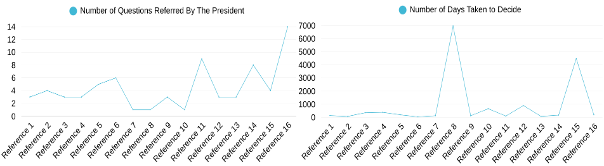
Figure 1: Comparison of the number of questions referred by the President under Article 143 with the number of days taken to answer the questions.
Furthermore, as demonstrated in Figure 2, in 18.75% of the references, i.e., three of the 16 references, the Supreme Court identified that the questions in the reference arose from a prior judgement of the Court to clarify or correct the position of law therein. These are Special Reference No.1 of 1998 (‘Third judges case’) from Supreme Court Advocates-on-Record Association v. Union of India, the 2G reference from Center for Public Interest Litigation v. Union of India, and the Governor reference from State of Tamil Nadu v. Governor of Tamil Nadu. This is particularly significant as it shows that 81.25% Presidential references arose out of extrajudicial developments, many of which involved politico-legal questions such as those on the validity of certain bills to settle political scores, or on matters involving federal cooperation where inter-state disputes could not be settled amicably. Even amongst the 18.75% references, the 2G reference arose out of a political scam for which the Centre had already filed a review petition against the Supreme Court’s verdict which was later withdrawn.
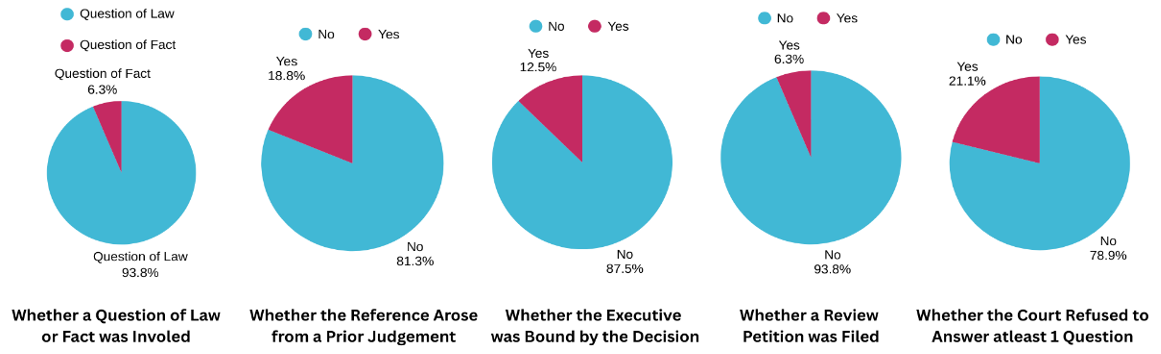
Figure 2: Pie-charts on key parameters listed in Table 1.
It can be inferred from these statistics and facts that the Presidential reference under Article 143 has most often been used as a political tool to bypass litigation in lower courts or to expedite the resolution of disputes of public importance given the high level of judicial efficiency under Article 143. This issue was highlighted in In the matter of Cauvery Water Disputes Tribunal in which the Court observed that the executive cannot use Article 143(1) as a pretext to overturn existing precedents. However, I contend that political motives continue to be the driving force behind the invocation of Article 143, since the opinion is merely advisory and the ruling government can either get a quick decision in its favour, or choose to not follow it if the decision is against it. Since neither is the Court bound to answer certain questions, and nor is the government bound to follow the opinion even if the questions are answered, there is a fundamental tension in advocating for mandating the Court to answer all kinds of questions. Hence, I argue that the Court has indirectly been conscious of this tension by answering only those questions which have arisen from genuine constitutional uncertainty. This position is substantiated by the fact that in two of these cases, i.e., In re: Kerala Education Bill, 1957 and the third judges case, the Court had to ask the executive for a declaration to be bound by the decision to put a halt to unnecessary litigation, even when advisory opinions under Article 143 are otherwise not binding.
From Figure 3, another striking trend can be observed. In the second half of all Presidential references, the Supreme Court constituted five-judge benches for all opinions except one, i.e., the Third judges case. From this fact, two inferences can be drawn. First, that there is a pattern of the Supreme Court fixating on five-judge benches in all cases under Article 143 in recent times. Second, that since out of the 8 instances where more than five-judge benches were constituted, five invoke questions pertaining to either federalism and centre-state relations or separation of powers between the three branches of the government, the Supreme Court tends to prioritize matters related to these subjects. I group the two together because both engage the structural architecture of the Constitution by implicating the functioning of foundational constitutional institutions such as the Union, the States, the executive, the judiciary and the legislative, whose operation cannot remain uncertain, and require authoritative clarification to ensure the stable functioning of the constitutional order. Since this functioning is dynamic and interdependent, I term matters in these two categories as cases pertaining to ‘institutional mechanics.’
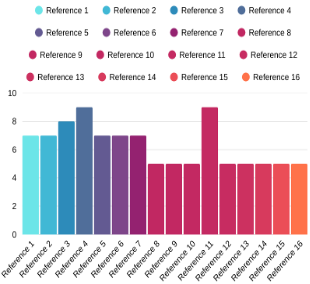
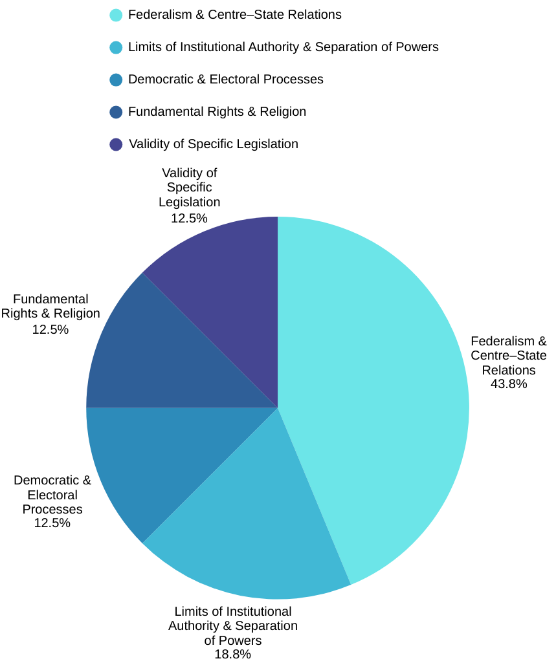
Figure 3: Bar graph showing the number of judges in each Presidential reference; pie-chart showing the 16 references by the category of questions by area of law.
These eight opinions averaged 7.6 questions yet were delivered in 172.6 days, five times faster than the overall average. Further, all questions were answered in these cases, while in four of the remaining 8 cases with five-judge benches, at least one question remained unanswered.
The afore-mentioned statistics indicate that the number of the judges is directly proportional to the number of questions asked in the Presidential reference. I argue that this has been a conscious judicial choice since this relationship remains constant despite the number of total judges in the Supreme Court expanding with time. Further, there is generally an inversely proportional relationship between the number of judges on the bench and the time taken to decide the matter. Thus, the Supreme Court thus weighs both the number of questions and their complexity when deciding bench strength. From Table 1, it can be observed that the bench strength and the number of questions are both higher than the average in cases involving questions of ‘institutional mechanics,’ which I assume to be more complex based on their functional constitutional implications as opposed to the assessment of the validity of statutes or the interpretation of fundamental rights. Moreover, ‘institutional mechanics’ matters are not only given larger benches but are decided with markedly higher efficiency. I term this phenomenon the ‘Institutional Mechanics effect.’
Mathematical Model for the Institutional Mechanics Effect
The Institutional Mechanics Effect is partially or wholly true for all the cases in Table 1. The only exception is the Governor reference. However, since the Court itself admitted that none of the other cases pertained to what the court termed ‘constitutional mechanics’ applicable in this case through the much narrower questions pertaining to the basic structure of the Constitution, the broad patterns that are generally applicable to Presidential references may not apply to the Governor reference. For the remaining references, the Institutional Mechanics Effect can be represented by the following equations.
Let:
- J = Number of Judges on the Bench
- Q = Number of Questions Referred
- T = Time taken to Decide the Reference
- M = A Binary variable representing the nature of the matter; where M = 1 if the reference concerns institutional mechanics; M = 0 otherwise)
Based on the findings in the previous section, the following equations can be formed, assuming extraneous and confounding variables such as extrajudicial or political factors that affect judicial practice and efficiency to remain constant.
Equation 1: Direct Proportionality Between the Number of Judges & Questions
J ∝ Q
Or J = αQ
Where α > 0, meaning that the relationship between the number of judges and the number of questions is positive.
Equation 2: Inverse Proportionality Between the Number of Judges & Time Taken
T ∝
Or T =
Where β > 0, meaning that the proportionality constant governing the relationship between bench strength and time is positive, implying that time decreases as the number of judges increases, consistent with an inverse proportionality model. Hence, this equation mathematically captures the observation from Table 1 that larger benches generally decide matters faster.
Equations for the Institutional Mechanics Effect
To incorporate the fact that matters involving institutional mechanics are assigned larger benches and are decided more efficiently (i.e., with lower 𝑇), another term can be introduced for when bench strength is increased: γM, where γ = the extra number of judges; and γ > 0.
So, if M = 0, i.e., in the ordinary case where the matter pertains to any other subject area other than institutional mechanics, γM = 0. It means that there will not be any increase in the number of judges in such a case. However, when M = 1, i.e., when the matter pertains to a case of institutional mechanics, γM = γ, i.e., the bench size increases.
Now, while it is evident from Table 1 that a higher bench strength yielded faster adjudication indicating better judicial efficiency, the data from Table 1 also shows that cases of institutional mechanics are decided even faster than what bench size alone would predict. That unexplained additional speed is what I model as ‘𝛿’ or the ‘additional efficiency effect.’ To put this concept to use, Equations 1 and 2 can be combined to give the equation for the Institutional Mechanics Effect.
J = αQ + γM
T = – δM
Where γ > 0, i.e., institutional mechanics increases bench strength; and δ > 0, i.e., institutional mechanics increases efficiency by reducing time. Further, in cases involving institutional mechanics, M = 1, i.e., T = – δ. It means that the δ or the additional efficiency effect directly subtracts time. Thus, δ measures how much faster these cases move because they are treated as constitutionally urgent and not just because they have more judges. In Presidential references, this subtraction can mean faster listing, judicial urgency, and streamlined hearings that are prioritized over other cases.
Substituting values in the above two equations, we get the combined structural equation for the Institutional Mechanics Effect.
T = – δM
This equation can be interpreted as a conceptual representation of the structural relationships observed in existing Presidential references. While certain patterns such as a larger bench taking faster decisions can be predicted, since the formulation is derived from in-sample modelling where the coefficients (α, β, γ, δ) are not empirically estimated and the Governor reference acts as an exception, the model functions as a schematic framework that illustrates the interaction between the number of questions, bench strength, and adjudicatory time in matters involving institutional mechanics. Nevertheless, the equation can be understood to mean that the existing trends indicate that in matters of institutional mechanics, it is likely that the Supreme Court may assign larger benches and undertake disproportionately faster disposals.
Why Questions of a Federal Nature That Relate to Institutional Mechanics Must be Considered Mandatory to Answer
Based on the Court’s opinion in the Governor reference that no previous reference had evoked a question on ‘constitutional mechanics,’ and that it was a duty on the court to answer at least some questions since they were questions of a ‘functional reference’, I contend that the Court in the Governor reference made a significant advancement on the question of judicial discretion in answering references by positing that an entire reference cannot be returned unanswered if some questions can be answered. However, I argue that since paragraphs 10 and 12 of the reference only impose a partial obligation over the Supreme Court to mandatorily answer any question which is within the Court’s institutional capabilities and pertains to the continuation of the Constitution’s democratic, federal and republican model, there is still scope for questions pertaining to institutional mechanics remaining unanswered in a reference, which is undesirable for maintaining a stable and clear constitutional order. Hence, Article 143 itself must be re-interpreted to plug this gap.
The rationale of the Court to leave the question in the Ayodhya reference unanswered, similarly clarifies that questions of fact whose answers could potentially violate the aspects of the constitution’s basic structure in spirit are non-justiciable. Extending this rationale, I contend that the reverse is also true, i.e., the Court must answer those questions, which if left unanswered, would lead to a state that violates the constitution’s basic structure in spirit. While the Court in the Ayodhya reference did not frame its reasoning in terms of the basic structure doctrine alone, its concern to prevent the advisory jurisdiction from interfering with the integrity of the adjudicatory process reflects a commitment to preserve the constitutional scheme. The Supreme Court in S.R. Bommai v. Union of India invoked basic structure principles outside the context of constitutional amendment, and in this light, it may equally be argued that for the purposes of Article 143, the Court ought to answer those questions where leaving them unresolved would itself generate constitutional uncertainty affecting the functioning of core constitutional institutions.
From this position, I argue that it is discretionary for the Court to give its opinion on questions referred under Article 143(1), but it is mandatory to do so for questions raised under Article 143(2), which involve questions relating to the kind of federal disputes listed under Article 131. The basis of this argument is the use of the word ‘may’ in Article 143(1), but ‘shall’ in Article 143(2). I rely on the expressio unius est exclusio alterius principle of interpretation to argue that the differential use of ‘may’ in one clause and ‘shall’ in another must be given meaning.
Notably, both Article 143 and Article 131 recognise questions of law or fact. The latter expressly specifies the circumstance when such questions are relevant to a dispute, i.e., when the existence of a legal right depends on such question. Applying this idea to the phrase “dispute of the kind mentioned in the said proviso” in Article 143(2), referring to federal disputes in Article 131, I contend that any dispute of the federal nature described in Article 131 is mandatory for the Court to answer. While Article (2) is confined to disputes of the limited kind referred to in the proviso to Article 131, the deliberate contrast between the use of “may” in Article 143(1) and “shall” in Article 143(2) nevertheless reflects a constitutional recognition that certain disputes implicating the federal structure warrant a mandatory advisory response. The differentiation therefore remains instructive in understanding the gradation of discretion embedded within Article 143.
Conclusion
The Instititonal Mechanics Effect is a theorised phenomenon that explains judicial efficiency in Presidential references under Article 143 involving the interpretation of the constitution. My submissions regarding the duty of the court to answer questions involving institutional mechanics is supported by the Court’s stance in the Governor reference as it was observed therein that it is the Constitutional duty of the Court to answer questions related to the roles of constitutional institutions, i.e., questions related to federalism. Hence, since legal rights depend on the nuanced answers to questions related to the quasi-federal character of the Indian republic, it is mandatory for the Supreme Court under Article 143(2) to answer questions pertaining to any aspect of federalism that holds a potential to lead to a dispute between states, and between the Union and the states. Such a question would not merely qualify as a question of ‘public importance’ in Article 143(1) whereby it is only discretionary for the Court to answer the question in the reference, but rather it would constitute a dispute of the kind that are mentioned in Article 131, and hence would be mandatory under Article 143(2).