
Assembling India’s Constitution: An Interview with Rohit De and Ornit Shani (Part II)
Rohit De
,Ornit Shani
The SLR Editorial Team, including Jyotika Tomar, Dhruti Kedilaya, and Chahat Bhambri sat down with Rohit De and Ornit Shani to discuss their latest book ‘Assembling India’s Constitution’. In Part II, they reflect upon constitutional endurance and how alternative constitutional imaginations shape our understanding of courtrooms, classrooms, and publics as spaces where these ideas can still be invoked.
A Fever of Constitutional Expectations
SLR: Your book makes several references to how deeply emotive the drafting process was, within the Assembly. For example, the Assembly’s concerns about separatism — the making of a “tribalistan” — conveys a sense of fear of the collapse of the union. Women’s groups demands for protection against sexual violence reframed dishonour as anger and unequivocal demands for dignity. Muslim members were frequently heckled for articulating community-based discrimination, and compelled to accept the “seemingly neutral language of abstract, unmarked citizenship” as the normative vocabulary of discourse. Could you speak to the idea of using ‘affect’ as a category of analysis for constitutional history?
Ornit Shani: The book is certainly rich with references to emotive experiences. Professor Mitra Sharafi also asked a question on the affective aspect of constitutional history which we engage with, at one of the book talks we presented at. The demands are framed through strong sentiments of hurt, honour and humiliation. Muslims, for example, make demands for the state to abide by evacuee property laws in the aftermath of the Partition migration. Women’s experiences of sexual violence during Partition migration framed their demands for constitutional recognitions of dignity in the Assembly. I think what it shows us is the level of expectations and aspirations that people held of the Constitution, in anticipation of wide-reaching transformation across society, polity and economy.
Rohit De: Scholars like Aditya Nigam and Vatsal Naresh have mapped the debates and tried to identify emotion within them, paying attention to the silences or what kinds of speech were legitimised and which demands considered legible, as opposed to others. This also comes across in judicial dicta, in its interpretations of the constitutional text. I think what lawyers are less equipped to do, and in my view, should attempt to do more is to think about the kinds of emotions which existed outside the Assembly in the engagements we trace, and think about how that imbues the text with legal meaning in different ways. Work on Dalit and tribal engagements with the Constitution sometimes cite anecdotes where the interviewee claims their familiarity with the text, saying that Article 1 abolishes bonded labour. Now of course, Article 1 does not say this but it reflects the belief of communities who see it as an emancipatory document.
One, it tells us that constitutional law is distinct from other kinds of law in that we cannot restrict our understanding of it to the text itself, or judicial interpretations of the text, but we should also look closely at the life of the constitution outside the courtroom or the Assembly. I think this also distinguishes the Indian model from the American constitutional model, in how claims are made. For example, you will frequently hear references to the First Amendment to the US Constitution in public discourse on free speech, but instead of references to Article 19(1)(a) of the Indian Constitution, will more likely hear statements acknowledging that the freedom of speech and expression is guaranteed by the Constitution, when the text itself places a long list of restrictions on the right.
To think about it in terms of jurisprudence, the Supreme Court recognised due process underArticle 21 which is the right to life and personal liberty, even though the framers themselves had excluded it. One way to think of this is the notion of judicial activism, or the idea that the court was responding to socio-political developments in the first few decades of independence. But according to the material we found, due process was a pressing concern for several individuals and groups engaging with the framing process in the 1940s. So perhaps, what Maneka Gandhi does is recognise an abiding sentiment that has been around for a longer time.
However, this doesn’t necessarily lead to progressive ends. Take the cow slaughter debates as an example, the Constitution has a very carefully worded provision on the demand to prevent cow slaughter, for Hindu religious beliefs. There has been mobilisation around this provision which has changed its understood meaning, as I show in Chapter 3 of A People’s Constitution. So it is interesting then, to look at how judicial interpretation and popular imagination imbues the constitutional text with meaning.
SLR: It is interesting to think through these ideas with Saadat Hasan Manto’s short story “Naya Kanoon” which describes a tonga driver’s idea of the Constitution as an emancipatory document. It shows us that our understanding of the Constitution might not translate to what it really is.
Rohit De: Manto’s story is about the 1935 Government of India Act, which was condemned by the national leadership as a terrible Constitution — Nehru called it Mussolini’s Constitution — but many ordinary people were very excited about it. Instead of focusing on the policeman dragging away Mangu in the end, the question we should be asking is why is it that this constitution is so exciting in the first place? Oishik Sircar has eloquently argued that this is an example of how the spectacle of law blinds Indians, and makes it a sort of illusion (I’m caricaturing this in some ways). What this shows is that law operates in unexpected ways.
To take an analogy, while Mangu might have been driven away by the police constables, one of the early constitutional cases adjudicated by the Supreme Court involves police constables filing writ petitions arguing that their rights have been violated since they had to take an exam in Hindi, in order to be promoted. There is a way in which the Constitution even pulls in those who were addressing other people’s rights. Upendra Baxi captures it really well, in saying that the Constitution is both an expression of state desire, as well as a site of insurgent imaginations. There is a danger in just taking one of these two without thinking of the relation between them.
Ornit Shani: To reframe this, it is worth asking if the test the abstract constitutional text, or is the test what happens once the constitution comes into force? When we see what happens once the constitution comes into force — which Rohit shows with his book, A People’s Constitution and we see with the list of schedules and amendments from independence to the present — we see that people’s engagement with the Constitution turns it into an open text, an open document, and an open site of struggle. This continues, and people see it as a tool they can use to negotiate claims and struggles.
Notes towards Alternative Imaginations or More?
SLR: It is productive to read your book in conversation with Sandipto Dasgupta’s recent book Legalizing the Revolution. He argues that the process of constitution-making worked by flattening the “radical” of the anti-colonial struggle. Can we read your arguments together with Dasgupta’s to note that though people were very significantly involved in constitutional claim-making, the lack of serious “official” engagement with these efforts left us with a constitution that in many ways, did not acknowledge or respond to them?
Courts around the world frequently rely on “framers’ intent” when interpreting the constitutional text and values. We know that some of our earliest and most landmark cases on fundamental rights, such as AK Gopalan and Anwar Ali Sarkar, cite a range of precedent from common law and foreign law but do not engage with even a surface-level acknowledgment of the political ideals of the anti-colonial movement. How does your argument — that the Constitution was shaped by multiple public imaginations rather than a singular set of framers — have implications for how the Courts use “framers’ intent” today? What does this do to our understanding of constitutional foundings?
Ornit Shani: It is interesting to read the sources you mentioned together. Texts like Madhav Khosla’s India’s Founding Moment, which is very much within the canonical frame, looks at debates and the origins as an enclosed set of things that are said to produce the text. For Dasgupta, the people are an abstract category, an apparition, an image, without real presence and the Constitution was written at a distance from them. In our work, the people, with their lived experiences, engage closely with the Constitution.
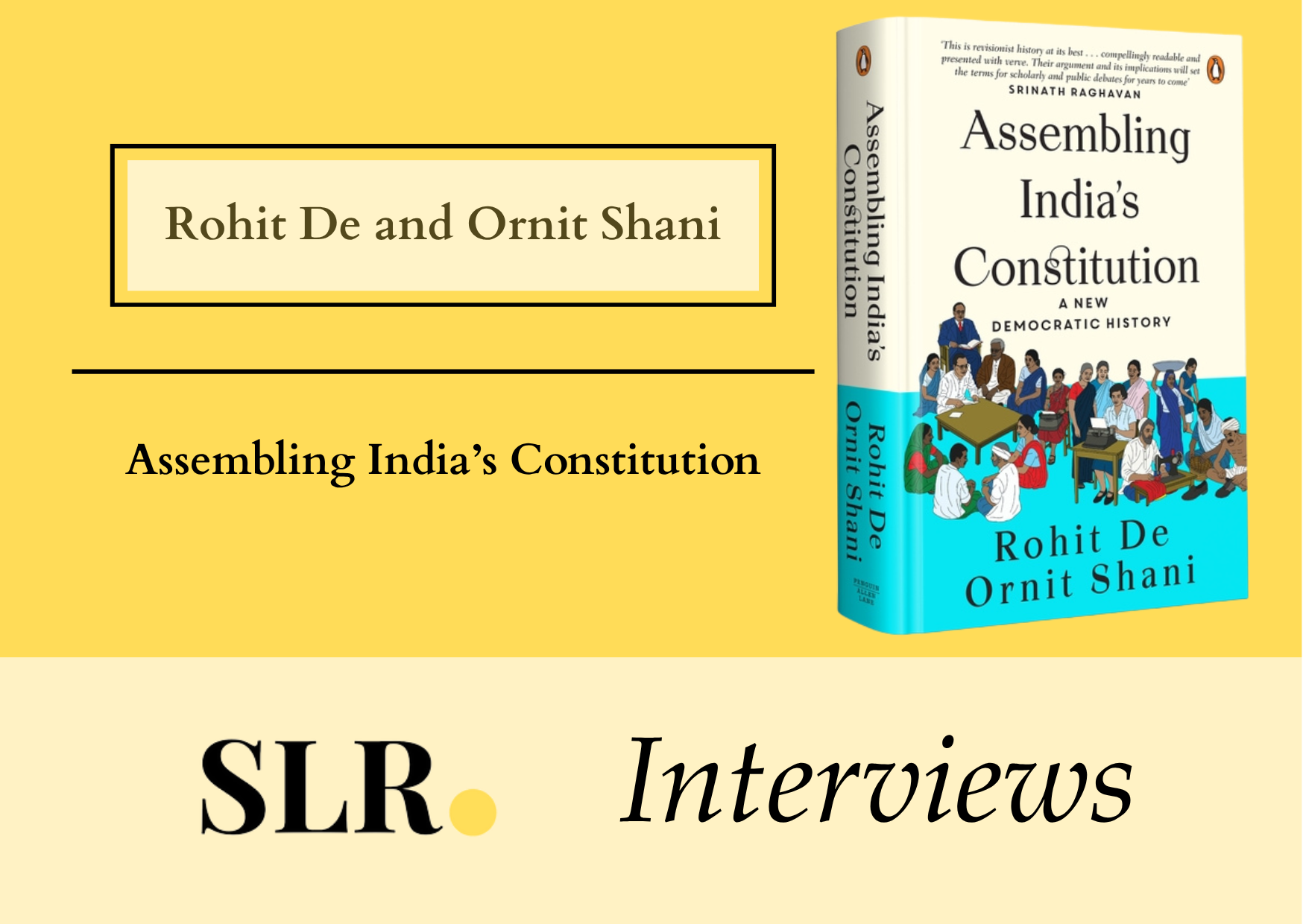
Rohit De: One way to think about the books is to put the covers together. Khosla’s cover has the colours of the national flag, and it is a book about democratic ideas and how surprising it was for them to have existed in India prior to independence. Dasgupta’s cover is in red, and his book seeks to understand the constitution as an expression of certain class interests. Our cover has people assembling, with an Ambedkarite blue in the background, which Siddhesh Gautam has done the artwork for.
In terms of the framers’ intent question, we are not claiming the American model of “going back” to original intent as an interpretative framework. We are not suggesting going back to uncover what the meaning of “freedom of speech” was in 1946, because things are going to change. We do, however, make the case that while we might not be able to give a textual meaning of every phrase, there are certain shared assumptions, and one of them is that the Constitution is not status quo. It is seen as something that is fundamentally going to challenge things like caste inequality, and it requires the state to come and play an active role in restructuring society. Even those interested in preserving the status quo recognise that they need to change their vocabulary of expressing those ideas.
In Anwar Ali Sarkar, Justice Vivian Bose, in his concurring judgement, mentions that he finds it impossible to interpret the Constitution without regard to the background out of which it arose. He says, “I cannot blot out their history and omit from consideration the brooding spirit of the times. They are not just dull, lifeless words static and hide-bound as in some mummified manuscript, but living flames intended to give life to a great nation and order its being, tongues of dynamic fire, potent to mould the future as well as guide the present.” Justice Patanjali Sastri reaches a similar conclusion, but with a significantly more doctrinal and formalistic interpretive method. For a special issue of World Comparative Law which hosted a symposium on the Indian Feminist Judgments Project, Tarunabh Khaitan rewrote the Anwar Ali Sarkar judgement, by asking the question of what new tools a postcolonial constitution offers for rights adjudication.
On the citing of foreign precedent, many of the petitions we worked with actually drew from foreign precedent, or argued that the rights they were claiming were rights enjoyed by other common law subjects around the world. A quest for indigeneity is a little misplaced, for various reasons. One, how do we define indigeneity? And two, we miss the fact that Indians were able to pick up and use ideas, regardless of where they come from.
Ornit Shani: The effort was to articulate claims in the language of rights by turning elsewhere — looking at where similar claims had been made, on what terms, and how successful they had been and what could be borrowed.
Rohit De: Law tends to be abstract — it selects from some contexts and abstracts from others, forgetting that it is the same person which exists across all these spaces. Tracing a judge’s individual jurisprudence, or a lawyer’s body of work is possible to do, but you also have to place these persons in the locations of whom they associate with — their caste associations, recreational spaces, conferences, and so on – to trace influences.
Ornit Shani: In the book, we pick up Hansa Mehta and Hasrat Mohani to illustrate the idea of how global the drafting process was and the many sites and spaces in which the Assembly members worked, but we were certain that examples of individuals other than them would have yielded similar results. Hansa Mehta is an example of someone whose body of work engenders a much wider constitution making process than just Delhi — her work with the United Nations, in Geneva, as well as with women’s groups in Baroda and various parts of India shows us that. These engagements, as well as what we know about popular engagements with the process explain the claims Rohit makes in A People’s Constitution — it is not as if the knowledge of the constitutional text descends upon the citizenry, but we know that they had a deep understanding of it by the time independence comes around. We can discern the shared expectation of the aspiration of transformation from the new republic.
SLR: As students, teachers, lawyers, policy makers or citizens – how do we think of these archives of historical constitutions and alternative imaginations of constitutional design in the present? The examples you cite of the suggestions they make are numerous — from recommendations for the right to recall a legislator, to provisions for the state governors elected on a popular vote and the restriction of executive power to issue ordinances or declare emergencies, among several others. They significantly reshape our notions of constitutional history, but do they remain in the archive as notes towards unrealised (and perhaps now lost) alternate imaginations or do you see possibilities for invoking them in courtrooms, classrooms, the Parliament and on the streets?
Ornit Shani: In his review of the book (linked above), Gautam Bhatia, a constitutional lawyer, saw a way that he could have made a normative argument on the history of public participation in democratic processes, that would have strengthened his case. The value of historical work traces the processes surrounding the making of the Constitution, foundational institutions and the text. Of course, we know that lawyers in courts do make arguments about historical cases.
Rohit De: I am generally cautious about judges using historical material. But your question recognises that judges are not the only interpreters who shape constitutional meaning. Parliament, the classroom, and publics are such spaces as well. Some of these memories are limited to communities, but often, communities themselves may not be aware that such claims were made. So, there is a purpose in having these ideas circulated and discussed. What does it mean to recognise that, at a time when sexual violence was so rooted in community honour, there were women members of the Assembly and outside arguing for state accountability for protecting women? Or, at the time when homes were bulldozed as punishment for rioters, there was a narrative that said, actually, if the riot happens, the state has to compensate everyone who had been rendered homeless because the state failed in its purpose to maintain law and order. To contribute to these conversations in public is ideally what the book should do.
Ornit Shani: The book and its discoveries are useful because there is this prevalent narrative being made over the years that this is not an “Indian” constitution, as Indians weren’t involved in its framing and it is merely a colonial imprint. It is perhaps useful for judges and courts to recognise that our Constitution is completely Indian.
Competing Constitutionalisms and Endurance
SLR: Please elaborate on the idea which you close with, that constitutional endurance has been made possible not necessarily by only its text but in the Constitution having become an active site of struggle.
Rohit De: I don’t think endurance is in itself a good thing. One of the reasons why, amongst most postcolonial states, the Indian Constitution has endured and why even political parties and movements that started off as opposed to either the specifics of the Constitution or constitutional modes of doing politics, at some point had to publicly acknowledge that it has provided common basis and common language for doing politics. On endurance, the Constitution has also shown the ability to adapt and change to the politics around it. Upendra Baxi describes the Constitution as an emerging site of struggle, but we show that in a way, this is learned from the making of the Constitution itself. It is not something that happens after the text is done. The making itself, and lack of fulfilment of demands, led to the creation of new publics and new politics. Perhaps the starkest space to see this is the North-East, or in violent and non-violent movements such as disability rights, and so on.
Ornit Shani: It is the process that enables these creations. It is not because there was a Constitution that suddenly made people rise. The causality is different. People were aware that the Constitution-making body was convening, and they engaged actively with the process.
This is the second part of a two-part Interview series. The first part of this interview is available here.

Rohit De
Rohit De is an Associate Professor at the Department of History at Yale University. He is a historian of modern South Asia with a focus on the legal history of the Indian subcontinent. Notably, he authored A People's Constitution: Law and Everyday Life in the Indian Republic.

Ornit Shani
Ornit Shani teaches Modern Indian History at the Department of Asian Studies, University of Haifa, where she heads the India Programme. She is the author of How India Became Democratic: Citizenship and the Making of the Universal Franchise.