
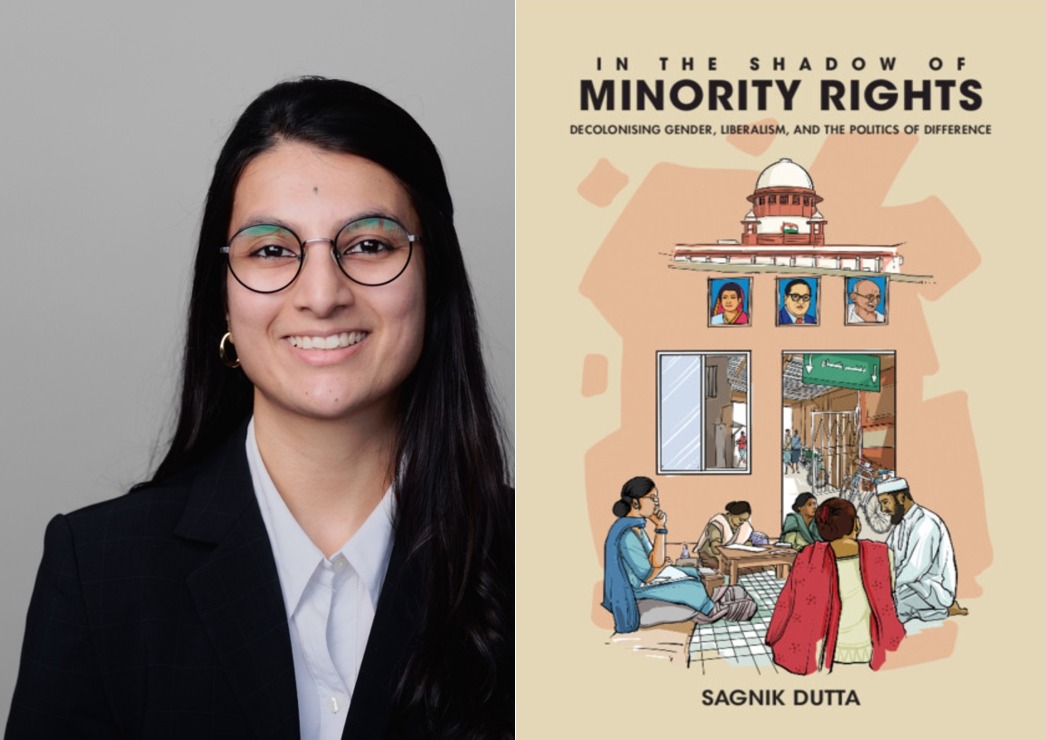
Book Review: Sagnik Dutta’s ‘In the Shadow of Minority Rights: Decolonising Gender, Liberalism, and the Politics of Difference’
Nidah Kaiser
Introduction: Situating the Book’s Intervention
There has been renewed public attention to Muslim women’s rights in relation to Muslim men, generated by both the historic Shah Bano case and its recent cinematic adaptation in the film Haq. It has led to debates on the limits of personal law to once again move to the centre of India’s political imagination. These moments, one juridical, the other cultural, have tended to cast Muslim women primarily as passive, symbolic figures through which the state, Islamic authorities, and majoritarian politics articulate competing claims about gender and minority rights. Departing from the dominant binary narratives that portray Muslim women either as victims of religious patriarchy or as passive recipients of state benevolence, and moving beyond the reductive frames revived by the film Haq and discussions sparked by it, Prof (Dr) Sagnik Dutta’s 2025 book, In the Shadow of Minority Rights, foregrounds women’s complex negotiations with both religious and legal authorities.
At the heart of Dutta’s work is the figure of the emergent “new Muslim woman” who seeks to break free from both political constraints and personal marginalisation, claiming a stake in democratic discourse. One of Dutta’s interviewees, Zakia Soman, also a founding member of the Bharatiya Muslim Mahila Andolan, articulates this clearly:
“In recent years, we have seen the emergence of a new Muslim woman. She is bold and articulate. She is not willing to be confined to the four walls of her home and wants to participate in the democratic discourse taking place in the country. Importantly, she does not trust the orthodox clergy to represent her. She is aware of her rights as a citizen and as a Muslim with her religion. She does not tolerate violation of her rights by anyone” (2025, p. 161; Soman, 2020).
This understanding differs from other conceptualisations of the “new Muslim woman”, including my own. In my work, the “new” identity is shaped through processes involving state institutions, rather than emerging solely from within women’s negotiation with their communities (Kaiser, 2025). In this framing, an identity is externally ascribed to Muslim women, and their portrayal shifts from being constructed as victims of Muslim men, in need of state protection, to being simultaneously positioned as subjects to be “securitised” and policed (Malji, 2021; Kaiser, 2025). These contradictory constructions, of victim and security threat, reveal how Muslim women become legible to the state only through narrow, and often racialised, scripts of vulnerability or suspicion.
In contrast to these competing conceptualisations, Dutta’s work reframes the debate by asking a central question: how do Muslim women, through everyday activism, reinterpret both Islamic and constitutional vocabularies to claim their rights and dignity? Rather than accepting the state’s binary imaginaries of the “new Muslim woman” as victimised or securitised, Dutta’s work shows how women themselves articulate alternative legal and ethical claims through grounded, everyday practice. By focusing on intra-Muslim feminist politics, the book situates itself within, and departs from, scholarship that has often been preoccupied with reform ‘from above’, through state-driven legal uniformity, rather than through the lived, interpretive labour of women themselves.
Theoretical and Methodological Framing
Dutta’s In the Shadow of Minority Rights is a careful and empathetic ethnography of intra-Muslim, gender politics in Mumbai and so, their methodological choices and self-positioning are crucial to the fieldwork. Working in Muslim-majority neighbourhoods as someone who is not Muslim, Dutta openly reflects on how their identity, as a nonbinary queer person who was assigned male at birth, and an upper-caste Hindu researcher, ended up shaping the relationships they built (p. 30). The book is an in-depth study of Muslim women’s activism that seeks to disrupt religious patriarchy and the male monopoly over Islamic adjudication of personal (and family) law. Dutta explains that that their own experiences of patriarchal control, harassment and vulnerability as a sexual minority helped them recognise, and respond sensitively to, the difficulties faced by the women with whom they worked.
The book’s empirical core is fieldwork with organisations such as the Bharatiya Muslim Mahila Andolan (“BMMA”) and the Mohalla Committee Movement (“MCMT”), and with the women who use, run and contest alternative dispute-resolution forums in cases including marriage and divorce. Dutta describes the workings of women’s sharia adalats and female qazis and the intricacies through which such activism, that involves both the Quran and the Constitution, serves as a state-society intermediary. This is done both, by engaging with Muslim men, and society at large, through re-reading and re-interpreting religious tenets, as well as in communicating, negotiating, and seeking help of the police and government officials.
Methodologically, Dutta’s involvement is not only as a researcher but also in the everyday work of the sharia adalats:helping women draft applications, accompanying litigants to police stations and women’s commission, and sharing routine responsibilities, allowed trust to develop gradually and gave them insight into the emotional and bureaucratic labour that structures these forums. At the same time, Dutta demonstrates awareness of the power differentials that marked their presence, especially the suspicion or discomfort shown by some men in the neighbourhood. This awareness informs a research ethic grounded in empathy: they approach women’s interpretations of Islamic and constitutional ideas without presuming neutrality or imposing theoretical templates from outside. Instead, they allow participants’ practices, dilemmas, and arguments to shape their analytical framework (p. 31). With this, Dutta aims to unpack ethnographically“the life-worlds of Muslim women in India” (p. 162), foregrounding the modalities of agency exercised by them in different times and contexts.
Dutta’s overarching intervention is to complicate debates about minority rights and legal reform related to Muslim personal laws. Part I of the book frames an ethical politics of spiritual equality of genders, emerging from textual engagement with the Quran and grassroots legal literacy; Part II traces everyday intimacies – and frictions – between activists and state actors (police, legal aid cells), showing how these generate pragmatic juridical outcomes in semi-public spaces. Both sections make the point that treating Muslim women solely as objects of top-down legal protection from “demonised” Muslim men reproduces a monolithic, communal patriarchy. In doing so, it foregrounds the importance of understanding the ways in which rights and juridical authority are being produced from below: in ghettoed neighbourhoods; in religious meetings and constitutional workshops; women’s organising, and everyday liaisons with the police and other arms of the state.
Here, Dutta’s feminist geopolitical method directs attention to the embodied and spatial dimensions of legal practice. This relates to how women’s agency unfolds in homes, local meetings, police stations, and community offices. The decolonial aspect of their analysis critiques liberal-secular frameworks that locate progress solely within state law (for example, the triple talaq law), instead centering subaltern Muslim women’s interpretive labour as a site of decolonial knowledge-making. Dutta operationalises these methods by tracing how power, law, and affect intersect across different spaces, thereby connecting micro-acts of negotiation to broader structures of sovereignty and nationhood. The book makes the following three essential contributions:
- The Dual Political Role of the Ghetto
First, the dual political role of the ghetto. Dutta shows how ghettoisation, whether produced by communal violence, marginalisation, demolitions, or property laws, paradoxically creates “safety-in-numbers” conditions that allow for emergent intra-Muslim politics to develop. Besides merely being sites of communal conservatism and sites of protection (Susewind, 2017), the ghetto enables women’s activities such as home-based trainings, mahila mandals, and neighbourhood grievance cells which become incubators for gender politics. Chapter 3, “Remaking the ghetto” offers accounts of Behrampada and Nagpada to show how the home, the narrow street, and the community room are converted into sites of legal learning and mobilisation. These sites of resistance underscore the role of the ghetto as a space that enables internal community dynamics to flourish – where intra-community politics can develop, gender rights can be asserted, and demands for legal reform can emerge. Besides enabling political mobilisation, Dutta shows how the ghetto empowers women’s knowledge-exchange and experience-sharing in close quarters, providing the potential to reclaim their rights within the Muslim community by using alternate resolution mechanisms involving state and non-state actors.
- Estranged Intimacies with the State
The second contribution is, the book’s account of the complex, intimate relations with the state. The book foregrounds a relationship of “estranged intimacy” (p. 126), in which activists cultivate everyday contacts with police and legal actors (sharing leaflets, helpline numbers, cordial banter), even though those relations can flip into antagonism when women assert their rights. In chapter 4, “Estranged attachments: The carceral state and the everyday life of Muslim law”, Dutta reconstructs how such sites – small, everyday spaces such as a corner room in a courtyard – operate as both adjudicative and pedagogical spaces. Female qazis, activists, lawyers, and human-rights activists and trainers use these spaces to circulate legal know-how, and cultivate relations with the police. Here, the interactions of women with the police extend in registers beyond their criminalised or securitised identities, where, in some ways, Muslim women embody power and constitute the state against their errant husbands.
Contemporary observations of the homogenisation of the Muslim political identity, within authoritarian contexts, overlook the complexities of alternate politics in intra-Muslim groups in their relationship with the state. The vignettes in this book demonstrate the state not as a single sovereign actor, but as a set of shadowy, material, and affective instantiations, which are evoked, mobilised, and contested in the everyday. Here, women activists utilise the threat of criminalisation of Muslim men, deeming the state to be not only a node of power, but also a node through which power may be sought, exercised or weaponised. Such creative uses of the state and law have also been pursued by women and marginalised people as a means of claiming agency through legal frameworks, including those addressing rape (Shrinivasan, 2021), anti-conversion law (Kaiser, 2025), and the atrocities act (Fuchs, 2024). However, what is different in this case is that these interactions produce a tortuous relationship with the state, which the author terms a “shadow” presence: a legal/political horizon that can be both protective and securitising. This chapter shows convincingly, how the BMMA both courts and weaponises state power, in specific cases of domestic violence or divorce, in order to secure maintenance or compliance from Muslim husbands, complicating binary views of the state as being sole protector or sole persecutor.
- Situated Alternatives to Legal Uniformity
The third contribution of the book is that it presents an alternative to the imposition of the uniform civil code (“UCC”). Speaking to the majoritarian debates around the UCC, introduced most recently in Gujarat and Uttarakhand, this book sheds light on alternate civil resolution mechanisms that centre women’s agency, maintaining both individual and community rights. In Chapter 5, “Between the home and the world, the many publics of Muslim law”, Dutta argues that state intervention in Muslim personal law has taken the form of criminalising the triple talaq. This caricatures Muslims as being a homogenous community with a personal law based on a gendered division of labour, where a claim to women’s rights mandates the criminalisation of men. In contrast, the semi-public sharia adalats serve as spaces that allow for a discourse on the fluidity of the gender roles through the public expositions of heterosexual family violence (p. 132). This fluidity shows up in the setting of the sharia adalat, where women do not simply act within fixed roles like “wife” or “dependent,” but instead frame their contributions to the household, such as care work and financial support, as forms of labour that deserve recognition and even compensation. As they shift between roles depending on their circumstances, sometimes relying on husbands, or supporting families themselves, or asserting legal claims, they show that gender roles are flexible and shaped by lived realities rather than rigid social or legal expectations.
The ethnography shows how sharia adalats stage affective pleadings and legal negotiation (maintenance, custody, re-characterisation of talaq), which do not map neatly onto formal legal categories can produce meaningful outcomes for litigants. It demonstrates empirically that community-based reforms (female qazis, women’s sharia adalats, negotiated drafting of model nikahnamas, and advocacy about triple talaq and khula) have the potential to offer a path to incremental change that is grounded in Islamic interpretive and feminist praxis, rather than the imposition of a Uniform Civil Code. The book provides an alternative to legal intervention into personal laws, emerging from within the community, and particularly, from women’s agency and through a politics of Islamic feminism.
Dutta’s deployment of a feminist geopolitical lens is analytically productive since it connects micro-practices of rights claims to broader constructions of the Muslim “other” in nationalist projects, thereby linking everyday gender contestation to larger territorialising projects of the state. Given rapid legal and political shifts (triple talaq criminalisation, UCC debates, anti-conversion laws in several states), which have been portrayed as being for the protection of women against Muslim men, the book opens questions about how these contemporaneous legal changes might reconfigure the “shadow” the state casts over these local institutions, i.e., whether recent central legislations strengthen, undermine, or reframe the usefulness of women’s sharia adalats.
Against this background, the book productively opens space for, yet leaves under explored, two main questions. The first is the looming question of caste. Historically silenced and erased Pasmanda Muslim women are, unlike their elite, upper-caste sisters, most often represented by others – governments, politicians, male religious leaders, fatwa-issuers and Waqf boards. These women may frequently be Sunni rather than Shia, and may typically be less organised than co-religionists in Bohra or Ahmadiyya communities. Such intra-community variation reflects the power relations within different sects, and shapes who gets to speak, whose grievances are prioritised, and what kinds of remedies, legal or social, are available. Dutta acknowledges class and contrasts the elite, Ashraf women with others, but the puzzle remains about how caste, class, and sect intersect with gender within the Muslim ghetto.
For instance, do access to BMMA resources or the capacity to litigate, vary by socio-economic status or family lineage? Would caste and sect location or occupational status affect a woman’s likelihood of approaching a sharia adalat against her husband, or invoking police assistance? Where intra-Muslim power differentials persist, these questions could be answered by a sociology of the women who interact with the sharia adalats, or work with them, including their demographic profile, caste and sectarian identity, occupational background, and prior contact with state institutions. An account of intra-Muslim stratification would prevent homogenising the category of “Muslim women”, as the ethnography itself suggests.
The second under explored question is the state’s securitisation of Muslim men. Dutta problematises those critiques that see BMMA’s support for the triple talaq law as a co-optation by the Hindu right. Yet, chapters 4 and 5 surface sustained tensions pertaining to the trade-offs of using state coercion as leverage against Muslim men. These tensions raise two distinct concerns: first, where intra-Muslim stratification exists, the bargaining power of husbands – shaped by their caste, class, and sect – may determine how readily criminal law interventions are mobilised against them. Second, invoking criminal law, even tactically, risks reproducing securitising narratives, as explored by other authors, which tend to cast certain Muslim men as dangerous, not only to women but also to the state (Ahmad, 2023; Iqtidar Khan, 2023). This could have wider consequences for the surveillance and policing of Muslim communities. The costs and limits of state coercion constituted in Muslim women’s activism can, potentially, come to bear heavily in authoritarian contexts, a period within which this book finds itself.
Conclusion
In conclusion, Dutta’s In the Shadow of Minority Rights: Decolonising Gender, Liberalism and the Politics of Difference is, thus, a timely, original contribution to scholarship on gender, law and religious politics in India. Occurring parallelly with the global Islamic feminist movement, this book focuses on local feminist interpretations of the Quran for resolutions to domestic issues such as marriage, divorce and violence in heterosexual families. In this way, Dutta brings out Muslim women’s everyday negotiations with authority, their multiple iterations of the state, the cultivation of everyday intimacies with the police, their reconstitution of the idea of the self in relation to that of the state, and the dual role of the ghetto. Its ethnographic richness and theoretical move – reframing the state as material, affective and spatially uneven – make it essential reading for scholars of legal pluralism, feminist geopolitics and South Asian studies.
References
Ahmad, I. (2023) ‘Securitisation of Muslims in India is as old as modernisation and nation-statisation’, Melbourne Asia Review, 6 September. Available at: https://melbourneasiareview.edu.au/securitisation-of-muslims-in-india-is-as-old-as-modernisation-and-nation-statisation/ (Accessed: 26 September 2023).
Dutta, S. (2025) In the Shadow of Minority Rights: Decolonising Gender, Liberalism and the Politics of Difference. Cambridge: Cambridge University Press. Available at: https://doi.org/10.1017/9781009582025.
Iqtidar Khan, F. (2023) ‘Securitisation of Religious Minorities in India and Pakistan: A Comparative Study’. Rochester, NY: Social Science Research Network. Available at: https://doi.org/10.2139/ssrn.4783133.
Kaiser, N. (2025) ‘“New” Muslim Women and the Myth of “Love Jihad”: From Victims to Security Threats’, South Asia Multidisciplinary Academic Journal [Preprint]. Available at: https://journals.openedition.org/samaj/9462.
Malji, A. (2021) ‘Gendered Islamophobia: The nature of Hindu and Buddhist nationalism in India and Sri Lanka’, Studies in Ethnicity and Nationalism, 21(2), pp. 172–193. Available at: https://doi.org/10.1111/sena.12350.
Nidah Kaiser
Nidah Kaiser is a Postdoctoral Research Associate at King's College, London. She holds a doctorate in Politics and International Studies from SOAS, University of London. Her thesis examines how legal frameworks and security structures shape violence against minorities.