
Denial of Death Penalty Amidst Public Outrage in the RG Kar Hospital Case – Reflections of the Defence Lawyer Post One-Year
Senjuti Chakrabarti
Kolkata: The courtroom of the 1st Additional District and Sessions Judge at Sealdah Court in West Bengal was unusually packed on that day. People stood shoulder-to-shoulder, struggling to find enough space to even place both feet. The crowd seemed almost unending as it surpassed the boundaries of the room, quickly filling up the corridors, flowing into the staircase at the back, and going beyond. The boiling anticipation of the public, including the media, protesters and doctors grew as the time for the pronouncement of the sentence drew closer. All eyes were on whether the court would impose the death sentence upon the perpetrator of the horrific rape and murder of a female doctor in the RG Kar Medical College and Hospital on 9 August 2024.
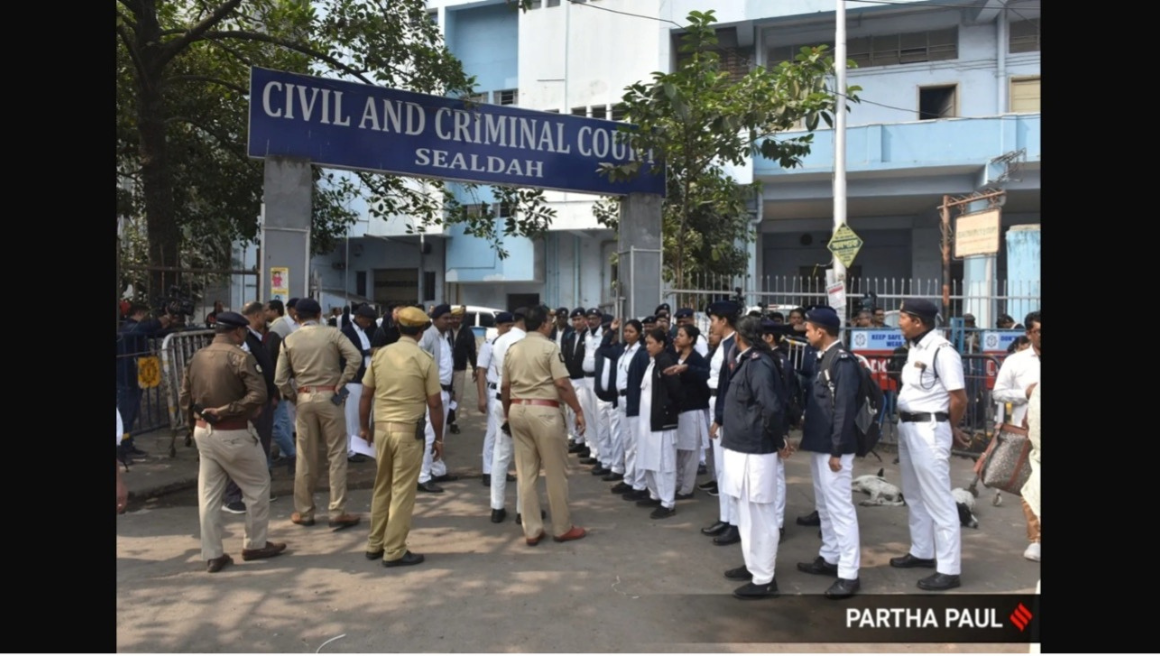
As time passed, police personnel dressed in white uniforms neatly distributed themselves across the small court room — a fraction of what seemed like an entire battalion engaged that day throughout the court building, extending to the grounds. At one point, one of the officers posted at the entrance pushed some of the people out to prevent the doors from breaking. He exclaimed worryingly, “these might fall apart any moment from all that pressure…”
The public pressure!
The public that had birthed the “Reclaim the Night” movement, shaken by the crime against a female doctor at work. The public whose desperate cry for justice broke out in the streets of Kolkata and spread like wildfire across the districts of Bengal and garnered nationwide solidarity with each day. The public, whose remarkable echoes of “Justice for RG Kar” heard from every corner, nurtured a demand for phanshi (death penalty) of the accused. A massive rally demanding the hanging of the accused was even led by the Chief Minister of West Bengal.
As the defence lawyer representing Sanjay Roy, the sole accused, I stood amidst this mayhem and wondered, “now that the public — which had agitated for five months to ensure ‘justice’ — had finally entered the courtroom, would its doors really fall apart? Would the vehement chants of “phanshi chai” (we want the death penalty) now sweep their way into judicial decision-making?”
The Slippery Slope of the “Collective Conscience”
In the last 10 years trial courts in India have sentenced more than 100 persons to death each year. Data from 2015 in three Indian states (Delhi, Maharashtra, and Madhya Pradesh) show how an overwhelming average of 55.26% of death penalty decisions passed by trial courts stated “satisfying the collective conscience” as one of the reasons. Interestingly, the phrase “collective conscience” — first referenced in Machhi Singh v State of Punjab, added onto the existing framework of Bachhan Singh v State of Punjab, which provided for individualised sentencing — a death sentence can be imposed only if aggravating circumstances outweighed mitigating circumstances, and the alternative of life imprisonment was “unquestionably foreclosed”. Now, it tied the judiciary’s responsibility to impose death penalty to the expectations of an outraged collective whose conscience demands the same. Thereafter, the phrase began to be frequently used by courts to justify a death penalty order, even though the phrase remains undefined till date, leaving it largely to a judge’s discretion.
But what is this idea of a “collective” with a common “conscience ”? Can a collective ever be homogenous? If not, then how do we look at masses of people going out in the streets together, demanding “justice”? Can this collective usage of the word “justice” even have a common definition? If not, then how do courts justify capital punishment in the name of the “collective conscience”? By this, do judges simply justify their personal will of hanging a person? Or do judges get swayed by pressure, misidentifying an angry and arbitrary public as a collective with a conscience?
Several such questions came rushing to me as I stood in the courtroom looking at a large fidgety crowd, who threw them at me one at a time. Questions that had found no space in my mind earlier throughout an otherwise in-camera trial. However, I do not intend to take this space as an opportunity to seek those answers now or try defining the “collective conscience”. What I rather aim for is to highlight the significance of the denial of death penalty by a trial court deciding a hyper-sensationalised and intricately scrutinised proceeding — where the media’s verdict of guilt was pronounced long ago and the public has now arrived only to see the judge conform. I intend to do so by putting forth a detailed account of my experience as the defence lawyer, from the morning of the sentence hearing till the final pronouncement of the court’s verdict on 20th January’ 2025, painting a picture of what a district courtroom really looks like when it is flooded with masses of people demanding “justice”.
For in my opinion, in the context of the 8 August 2024 incident, each time the “Reclaim the Night” movement is recalled for its collective imagination of safe workspaces for women, one must also revisit the sentencing day in the same breath, in recognition of the trial judge’s conscious distancing from such a “collective” and writing a decision — imagining justice — at the risk of being unpopular.
Public Outrage and Imposition of the Death Penalty by Trial Courts
The emotion around a possible death sentence for Roy was so heightened that it felt that if the final court verdict granted a death penalty, it would be read as somewhat legitimising the populist demand raised on the streets persistently for over five months. A demand that had also compelled the State of West Bengal to pass the Aparajita Woman and Child (West Bengal Criminal Laws Amendment) Bill in September 2024 making death penalty mandatory for certain offences including rape and murder.
While I would argue that a courtroom and a movement space must be looked at separately, and that each has a distinct role in the idea of justice, I witnessed the lines between the two blurring as I sat amidst the public that day. I wondered to what extent each can really distance itself from the other while also being appropriately informed by the other.
The question was answered in some form that day through the judgement.
Here, I must confess that before the sentencing day, as a defence lawyer I had not felt the responsibility to delve into these questions either. The reason perhaps is that the trial proceedings were being held in-camera for around two months, far away from the desperate, chaotic cries of the streets. Lawyers of all parties used to spend prolonged hours behind closed doors, with only the accused person, parents of the victim and the judge along with his selective staff. We fought and opposed each other at instances, and soon, by the nature of the profession, transitioned smoothly into amicable exchanges. The closed door of the room maintained a stark barrier between a fascinating public rage brewing outside and a mundane courtroom proceeding inside. This barrier was periodically removed only for a chai dada (tea seller). Possibly being conscious of the unimaginable scrutiny of the public outside, he would sometimes bring aloor chop (potato pakoda) on the longer days for a team of hungry and tired lawyers who were locked in.
Till that time, I, perhaps like the judge too, was perceiving an abstract idea of this “public” and the “outside”. We both knew of their existence through the all-day news cycle — but only as something that ran parallel to the proceedings, not physically proximal to the court, let alone intersecting with it. Therefore, on the sentencing day, with the doors opening for the public, the “inside” of the courtroom space collided with the “outside”, almost merging with it. The abstract public and its “pressure” were upfront and close now — reminding me, and perhaps the judge, of the significance the decision made inside would have on the anticipations of “justice” that brewed outside.
Experiencing the “Public Anticipation” Upfront
On the morning of the 20 January 2025, as I made my way into the Sealdah Court premises, walking through its long and diverse path leading to the main building, I intimately experienced the “collective”, one person at a time. From the main road, I took a left towards the court and heard few women walking beside me, one reminding the others, “how can a woman defend a rapist?”; while another quickly responding, “if she has a conscience, she would also want a death penalty today.” I walked on straight through a perpetually busy Sealdah Market space and caught the exchanges between shopkeepers and buyers. “Whatever happens today, such criminals must actually be hanged.” Someone replied saying, “if in this case, the wrongdoer is not hanged, I will doubt the justice system.” I walked on and found myself amidst a crowd rushing for or from the Sealdah Station located right ahead, them walking hurriedly while playing live footage on their phones showing minute updates of the convict boarding the prison van to passing a crossing to reaching the court.
I walked faster but the overwhelming anticipation had almost devoured me. Before entering the building, from within the additional space created for a large squad of police officers and long barricades, especially for the anticipated security concerns that day, I heard a police personnel exclaim, “I wonder who Roy’s lawyer is! Will they even dare to appear today?” I was stumped but soon awakened by loud chants of “phanshi chai” (we want the death penalty) emerging from protest groups stationed wherever one could see. Once inside the court, I was schooled by senior lawyers saying, “…now that you have chosen to come, don’t be upset after the verdict. The world knows what it would be, it must be written already. Recall Dhanonjoy’s matter!”.
Dhanonjoy Chatterjee was held guilty for the rape and murder of a schoolgirl and was executed in 2004 pursuant to the Supreme Court holding that his death penalty was an “appropriate punishment that would enable courts to respond to society’s cry for justice’’. Years later, several researchers and lawyers have published reports citing major anomalies in the investigation, trial and the judgement, underlining the possibility than an innocent man might have been hanged.
Entering the courtroom now and wanting to oppose a death penalty felt like resistance, an added effort to not be shaken by the mass.
The Moment of the Final Verdict
Once the lawyers settled down in the familiarly empty room, the staff informed us that the door would open for the public on that day. As they opened, in the blink of an eye an outraged crowd hungrily waiting outside rushed inside like a violent wave, occupying every inch of the space inside within seconds. Every inch even included around the judge’s ejlas (seat of the judge) which is a strict no entry zone in any court. Today the courtroom was compelled to remove its rules and make way for the people. The judge sat tall, amidst a crowd that could almost touch him. His usual upright and calm demeanour now looked unusually cold and more conscious to me.
As I struggled to find a space to stand up and argue, I felt with every second that my resistance in the form of showing up to the sentence hearing perhaps also exposed itself to the risk of conforming to this idea of “public conscience”, now standing in flesh and blood before me. It was as if my literal struggle to find space to stand and speak amidst the clamour was also metaphorical.
The accused was taken out of the lock-up and stood in the witness box to my right. I found him looking at the sea of people to his left for a few seconds. They had their eyes set on him. Perhaps overwhelmed and sensing the opinion of the room, he quickly moved his face away. Before I started, he murmured to me and then to the judge saying, “apnara janen ami kichhu korini” (you know I did not do anything).
Amidst this, I submitted against his death penalty — my prayer for life surreally intersecting with repeated echoes of “death!” reaching through the windows.
Public Appeasement versus Discharging ‘Justice’
Hannah Arendt writes in her 1994 book Eichman in Jerusalem, about how public sentiment in favour of revenge can pervert the ideas of justice. She condemns a “show trial where a public must be appeased, regardless of what a true notion of justice might be.” She writes that justice demands seclusion — sorrow, and not anger.
Is this seclusion possible for a trial judge sitting in a district with such proximity to the public? Especially when Indian trial courts passing the death penalty, are often inclined towards being “oracles or spokesmen of public opinion”.
I looked at the judge wondering whether he too was experiencing this same space differently now. I recalled Justice Kurian Joseph’s words the judgement of Chhannu Lal Verma v State of Chattisgarh 2018,on the effect of public pressure on the court. While commuting the death sentence and as a dissenting judge on the bench critiquing the capital punishment, he wrote, “it has almost become a trend for the investigating agency to present their version and create a cloud in the collective conscience of the society regarding the crime and the criminal. This undoubtedly puts mounting pressure on the courts at all the stages of the trial and certainly they have a tendency to interfere with the due course of justice.”
Do judges sitting at the highest court, conveniently distanced from society, understand this push and pull a trial judge faces due to the pandemonium playing out inside courtrooms? In fact, there may be critiques of trial court decisions strictly based on the Apex Court’s sentencing guidelines. However, the question remains whether such compliance, or its lack thereof, of the highest court’s directions can be discussed devoid of the unique context of the bottom rung of the judiciary.
So, after my submissions, when my eyes met with the judge’s for a fraction of a second, I silently asked him, “are you able to isolate yourself from the rage boiling around you? Or if you are at the brink of giving in?” Perhaps just like the courtroom door, which, at the final hour, stood at a risk of breaking away, the very door that was held onto strongly by all actors of the proceeding for the past months to save the dignity of law from the storm around.
After the hearings, the court did go into seclusion for an hour, perhaps as Arendt says, in sorrow, or in anger. The judge came out to declare his decision to not impose the death penalty. In the last portion of the written order, as if to respond to all my silent questions, he concluded
….this case calls for a carefully considered and appropriate sentence that balances the gravity of the crime with the principles of justice, rehabilitation, and the preservation of human dignity. The court must resist the temptation to bow to public pressure or emotional appeals and instead focus on delivering a verdict that upholds the integrity of the legal system and serves the broader interests of justice…
Conclusion
The judgement is certainly not a commentary against the death penalty as a form of punishment. Especially because that same year, the same judge passed a death sentence upon another 35-year-old Sanjoy (Sen), citing how the aggravating circumstances such as the manner of commission of crime and the brutality placed it within the “rarest of rare” category.
What I recall after a year is the judge’s conscious choice, rather risk, of refusing to justify yet another death penalty order as an act of responsibility towards an indignant mass — leaving it upon the higher courts to later adjudicate the rightfulness of such sentence when voices in the streets have calmed down. It is this drawing of a line between the court and the street, despite the uproar is what is pertinent and should be remembered. Therefore, the significance of the judgement of 20 January 2025 lies in a trial judge’s resistance in not being tempted to justify legal decisions based on the myth of satisfying a “collective conscience”.
Featured image from the Indian Express, taken on 20 January 2025. It captures the security at the Sealdah Court premises on the day of the judgement.

Senjuti Chakrabarti
Senjuti Chakrabarti is a criminal defence lawyer who represented the legal aid defence team for the accused in the RG Kar Hospital case, particularly arguing his sentencing. She continues to represent the accused in the High Court at Calcutta as his legal aid. She has been mostly practising as a full-time legal aid Trial lawyer in the District Courts in West Bengal. She was also briefly associated with the Square Circle Clinic, NALSAR University of Law, working on death penalty cases.