
Reading Dezalay’s Lawyering Imperial Encounters: Negotiating Africa’s Relationship with the World Economy
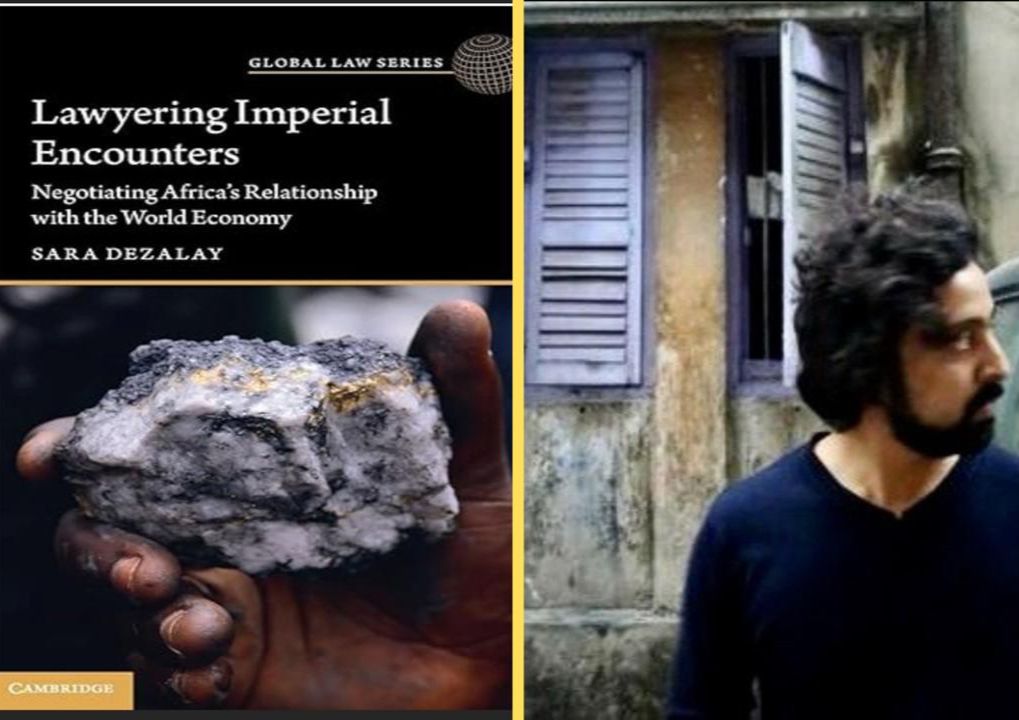
Anandaroop Sen
Lawyering Imperial Encounters: Negotiating Africa’s Relationship with the World Economy (Cambridge University Press 2024) has one critical, if straightforward question. How does law insert Africa into global economies of extraction? In other words, what is law’s relationship to economies of imperial extraction?
To answer this, the book embarks on a balancing act. It details “systemised logics” of law while sketching the historical artifice within which such logics could and did operate. The book’s strengths and weaknesses lie in this search for balance. How far does one wade into the internal dynamics of a system that is organised to facilitate extraction at different periods and points of a value chain without being swallowed by its seeming autonomy? Politically, how much weight should one allocate to an intellectual pursuit, notwithstanding the inarguable utility of studying the master’s tool to undo the master’s house— to understand law’s self-description? But if one abandons the minutiae, the web of quotidian law-powered extractive practices, is one left with an empty political?
The reader could rightly point out the redundancy of this binary. An opposition to corporate law and lawyers (I am reminded of David Graeber’s tongue-in-cheek comment in Bullshit Jobs, how many does the world need?) is not the same thing as demystifying the work they do. Dezalay is not necessarily on either side of this divide. Instead, she tries to map the emergence of a political field in which corporate law (Wall Street), in tandem with British common law, increasingly shapes the rules of engagement and extraction across the African continent. By doing this, she draws unequivocal attention to certain genealogies of the political; genealogies that perform the great vanishing trick of making politics disappear into law. However, to stop this disappearance, to retain the autonomy of law without succumbing to its autobiography, Dezalay has to push against the opposite historiographical current, one that makes law disappear into politics. A classic example: dependency theory. Here, the imperial legal institutions and the powerful but uneven travel of the rule of law did not receive adequate attention as internal articulations of uneven development. The local conditions that contested and shaped the imperial disappeared under the external architecture of dependency.
EP Thompson was one of the few Marxist historians in the West who was partially alive to this problem, as Nasser Hussain shows in Jurisprudence of Emergency. Hussain took up the mantle to re-stitch questions of sovereignty to those of the biopolitical in his foundational work on emergency legislation in South Asia. He could be faulted, though, for making law disappear, again, into politics. One can argue that this is bound to, indeed should happen, when writing a history of emergency legislation directly implicating the colonial state in coercive violence. However, in conceptualising economic histories of the colonial state, the relationship between the political and the legal became a more complex enterprise.
This is a problem familiar to readers of Ritu Birla’s work. Birla’s argument, in presenting law as an instrument of the colonial state deployed to manage the household, which separates the cultural from the economic, and constrains vernacular capitalism’s articulation, is an excellent example of accepting this challenge. Dezalay, by focusing on the generative practices of extraction and law, alerts the reader to similar bifurcations — for instance, where the state and corporation operate, what are the lines of demarcation, where and how such demarcations are established, etc. In other words, how does the sphere of economy emerge?
Yet one finds in Birla’s work a somewhat oddly exalted figure of the Marwari as the creative intermediary interrupting the universalism of capital. Political and economic histories of different hues would be uncomfortable with this vanguard role being bestowed on the Marwari merchant. One wonders how Indian histories of labour would speak to such claims of vernacular capitalism, and, more importantly, what the political claim of such an argument is in relation to the nature of the Indian state? (What does it mean to see rain gambling as almost an insurgent practice of colonial India?)
Dezalay encounters a similar problem. By zooming in and out of global value chains, the political and ideological stakes of state formation are relegated to a historical background. It is for this very reason that Lauren Benton is fundamental to Dezalay’s conceptual architecture. Drawing on Benton as well as Ford, Dezalay argues for the neologism “lawyering.” The argument goes something like this: historically (in the nineteenth and twentieth centuries) law was fundamental in creating middle spaces, institutions, collectives and individuals, operated in this middle kingdom where the rules of extraction were etched and imbibed. Therefore, imperial extraction, for the skilled native practitioners at least, provided opportunities for accumulation and escape. Consequently, particular social groups in the empire were able to partake in the promise of the middle kingdom of law. After political decolonisation, these groups were poised to take over the reins of new regimes of extraction.
This thesis is not new. Mahmood Mamdani, in the late 1980s, outlined the structural weakness of the African bourgeoisie. This weakness made the class cripplingly dependent on the state. Any form of accumulation was tied to the largesse of the state. Corruption was a form of accumulation for the bourgeoisie, who were often administrative agents of the state. In such a system, the legacies of imperial distribution of social capital through indirect rule played a crucial role. Thus, a situated class analysis had reached this conclusion without resorting to the convoluted middle ground of lawyering.
Still, the warning of not turning law into a byproduct of politics is well heeded by Dezalay. This is why Dezalay wants us not to remain hexed by the why of extraction, but to turn to the how and the where. Concentrate on the mechanics of how things operate on the ground. From such inductive operations, the hope is that perhaps one will begin to grasp the plurality of jurisdictions organised around extractive logics.
Yet, what we end up with, after turning to the how and where, is that law appears to be doing what class-oriented political histories, like that of Mamdani and Issa Shivji, have long argued: clearing space for extraction and accumulation while offering material for social hegemony. With Dezalay, we now have a map of how this happens contemporarily, and one cannot undermine its importance, but are we any wiser than saying that the contradictions of law are very much the contradictions of capital? Does one need a neologism (lawyering) to explain this?
One could argue that the way history is inserted in the book reflects this slightly tortured path. History is incidental. It is a background. Despite claims, there is no real change in the expected periodisation of the twentieth century: imperial (1880s-1950), post-colonial national (1950s-80s), and neoliberal (post-1980s). This remains even as Dezalay draws on Vanessa Ogle’s work, which does interrogate this periodisation.
Ogle tracks the rise of offshoring practices, particularly tax havens, during the period of political decolonisation, as a response to threats posed by the New International Economic Order (‘NIEO’) and to the nationalisation of resources by governments of new nation-states in Africa and Asia. Ogle argues that many of the offshore practices of capitalism were nurtured during the peak years of post-colonial resource nationalism. Later, this built infrastructure of offshoring (illegality) was transferred to mainstream capitalism after the 1980s, a period usually seen as the beginning of neoliberalism. Thus, onshoring and offshoring practices have a co-constitutive, continuous history that belies the clear separation of corrupt and legitimate spheres of economic activity, prompting us to rethink the chronology of neoliberalism. Yet this insight, though referenced, gets lost in Dezalay. It is unsurprising, then, that the political promise of NIEO (something Ogle traces in another article), the rise of the language of individuated and abstracted human rights on the debris of the promise of collective state rights to economic sovereignty, is elided in Dezalay’s narrative. If one is looking at lawyers and lawyering as principal agents of political transformation (or lack of), one is bound to find them. But in such a search, does one not risk missing the forest for the trees? Especially when there is evidence of alternative world-making projects which were not entirely captive to the process of lawyering.
In one sense, lawyering is an analytic that can only be sustained if written as an elegy of the political. And to be fair, Dezalay does recognise this when she talks about post-Cold War judicialisation of politics (see particularly Chapter 4, ‘The New Scramble, Deregulation, Re-Regulation’). This is the book’s most important, if not the most original, insight. What historical conditions enabled the overwhelming judicialisation of political processes, and how is this hollowing out of the political carried out by lawyering?
First, for the imperial period, Dezalay draws on Lauren Benton and Lisa Ford’s formulation of the British Empire as a middle power endowed with “lumpiness.” This refers to the uneven control the empire exerted over different spaces within and without, which gave rise to specific regional and local conjunctures. This unevenness law mediated, thereby turning law into a “vernacular.” This middling power established the lawyering infrastructure (an analogy that comes to mind is what the undersea telegraph cables were for the emergence of the internet) that shapes the politics of post-colonial African nations.
Second, while analysing the post-1980s rise in interstate adjudication and arbitration bodies, more in the African continent than anywhere else, Dezalay demonstrates how these forums are organised according to the logics of repeat players. Here, by “players” she means the users and providers of justice in these institutions, like the Permanent Court of Arbitration, the International Criminal Court, the International Court of Justice, the International Centre for Settlement of Investment Disputes, etc.). There is a constant overflow of personnel across political and commercial adjudication, leading to the judicialisation of politics. Despite historical changes (from empire to political decolonisation), a certain profile of practitioners who inhabit these bodies has emerged, creating an echo chamber of professionals increasingly immersed in corporate and commercial law.
Thus, not only is one faced with the disappearance of politics into problems of law, but into a specific kind of corporate and commercial law. Fed into this machine, emerging solutions to political problems are coded in the language of the market, a process Philip Mirowski underlines as a key feature of the neoliberal thought collective. Mirowski is a good guide here because he refuses to relinquish the ideological content of the neoliberal thought collective. While histories of practice are central to orienting ourselves to the fact that economic and legal practices are human conventions and not fate, one should not abandon the ideological coherence of imperialism as a key principle of extraction in Africa.
Finally, a recursive question while reading Lawyering Imperial Encounters was how to conduct such research. Given the deliberate opacity of the transactions involved. In a field where most conflict-of-interest cases do not see the light of the court but are instead managed through arbitration, out-of-court settlements and settlements outside public records, augmenting the know-how of legal actors who acquire the expertise of this argot, how is one to access the information and trace the lines of these transactions? In other words, what is the archive for such a history? Dezalay answers this in Chapter 1. She has extensive experience in the legal markets of conflict resolution, NGOs, academia, particularly in Burundi and Rwanda. She was a United Nations High Commissioner of Refugees-appointed judge (for asylum seekers) in the Cour nationale du droit d’asile (‘CNDA’), also known as the National Asylum Court in France. Her archive was created out of different projects across her career. The book retains this awkwardness. Assembling different archives to answer questions it is not prepared for is a testament to the analytics of “messiness;” not to baulk at the seeming “chaos” of a new wave of extraction, but to embrace the complexity of this world. All of this is convincing and points in an interesting direction; the people who can write histories of such dynamics in some empirical detail perhaps have to be insiders, part whistleblowers, part practitioners. Dezalay accomplishes this well. However, the billowing history behind the insider detail of extraction makes a less compelling case.

Anandaroop Sen
Dr Anandaroop Sen is a Senior Lecturer at the Department of Historical Studies at the University of Cape Town, South Africa. He is interested in how commodity extraction and state violence have been managed juridically across the British imperial and post-imperial worlds, delimiting and defining the fields of political action against (and for) the state. To answer this question, Professor Sen has sought to understand the political economies of states of exception and emergencies. His work aims to identify pathways that connect the routines of economic extraction (imperial and post-colonial) to juridical architectures of exception and emergency. Doing so, he brings together the archives of everyday practices of extraction under capitalism and the exceptional legal apparatus of emergency governance—the tear in the fabric and fable of Rule of Law— in a single analytical field.